
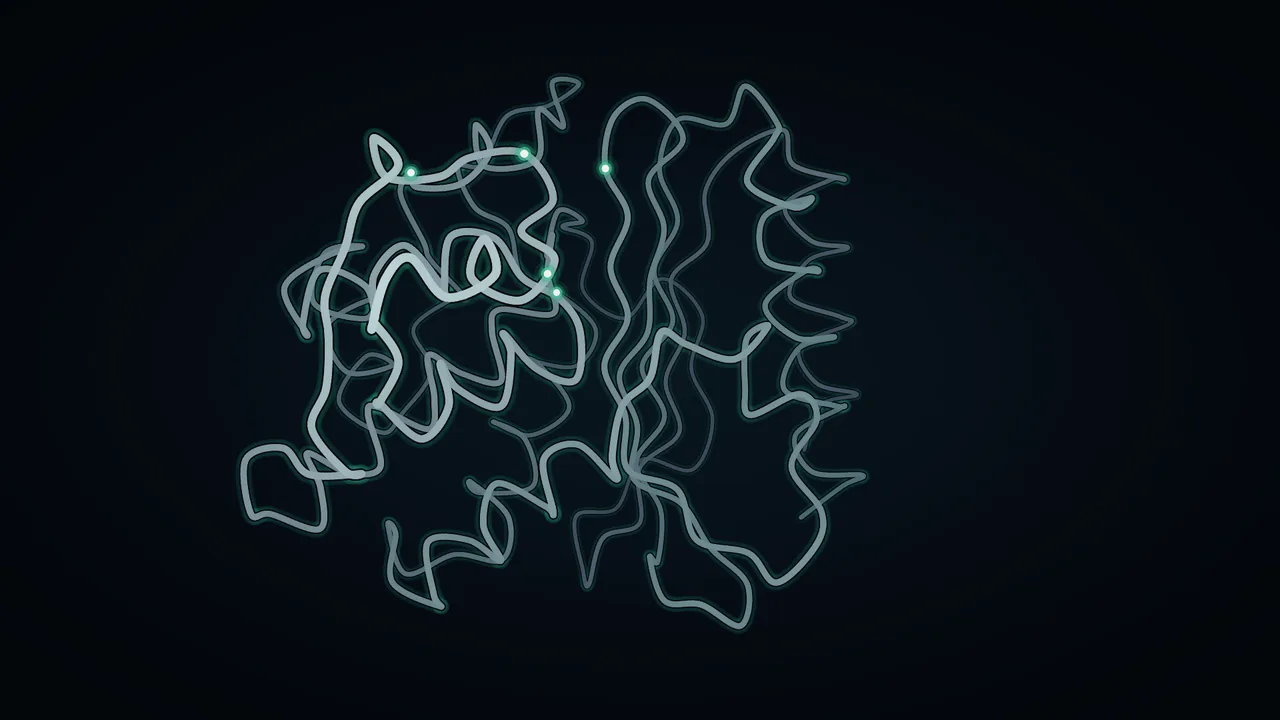
Protein engineering services
Protein engineering CRO services including deep mutational scanning, affinity maturation, directed evolution, and AI-driven enzyme optimization for biopharma and industrial biotech
Start a project →Choosing the right protein engineering method
There is no single best method, only the right one for the problem in front of you. The first questions we ask: what are you optimizing, is there data to learn from, and can the property be measured cleanly? The answer points to one of three paths, and they are often combined.
AI design
Some properties already have enough experimental data to train a model. Thermostability is the clearest case: we design candidate sequences computationally, then confirm them empirically. The model proposes, the bench disposes.
Deep mutational scanning
Scoring every single substitution maps the full fitness landscape in one experiment. For antibodies this is how we run affinity maturation across the CDR loops, and the same map guides where directed evolution should search next.
Directed evolution
When the property cannot be predicted and is hard to measure directly, iterative rounds of mutagenesis and function-based selection get there empirically. It pairs naturally with deep mutational scanning: map the landscape, then climb it.
Protein engineering approaches for every stage of development
Directed Evolution
Iterative rounds of mutagenesis and selection to improve protein function. We construct random or focused mutagenesis libraries, screen via display or functional assay, and advance the best performers into the next round.
Affinity Maturation
Take a confirmed binder and engineer it for tighter binding. Focused mutagenesis libraries around the binding interface, screened under increasingly stringent conditions. Starting from micromolar affinity, we routinely achieve 10- to 100-fold improvements across 2-3 rounds.
Deep Mutational Scanning
Systematically measure the effect of every possible single amino acid substitution across your protein. The output is a complete fitness landscape showing how each mutation affects binding, expression, stability, or enzymatic activity. Also applied to drug target biology, mapping how mutations affect drug binding and resistance.
Enzyme Optimization
Begins with computational assessment of the enzyme structure to identify positions most likely to improve performance. Structure-guided predictions narrow the mutational search space before wet-lab screening. Computationally prioritized variants are synthesized and screened using custom functional assays.
The method is rarely the problem. The assay is.
Most protein engineering campaigns do not fail on the choice of method. They fail on the screen. The situation we see most often is a client who arrives with an assay that looks fine on paper but is not robust enough to survive selection pressure. The moment you push a library through it, the signal collapses, the controls drift, and the enrichment is noise rather than biology.
So before we commit to a campaign, we pressure-test the assay, and we rebuild it if it is not ready. That validation phase is not overhead. It is the difference between a clean fitness landscape and a wasted screen, and it is the single highest-leverage thing a protein engineering partner can do for you. The engineering method is the easy part once the readout is trustworthy.
How a protein engineering project runs at Ranomics
Every engagement follows the same disciplined process. Timeline and scope vary by project complexity, but the structure remains consistent.
Scoping and assay validation
Technical consultation to define the target, strategy, and success criteria, then we pressure-test the screening assay for signal window, controls, and reproducibility before committing. SOW within 5 business days.
Library construction
Variant library generated via site-saturation mutagenesis, error-prone PCR, or gene synthesis. Library quality verified by NGS before screening.
Screening and selection
Display-based screening (yeast or mammalian) with FACS/MACS selection, or custom functional assay. Multiple rounds for directed evolution campaigns.
Analysis and delivery
NGS quantification, enrichment analysis, fitness scoring, and ranked candidate list. Full technical report with methods, data, and recommendations.










Foundational papers in protein engineering
Protein engineering is an empirical science with a deep methods literature. These are the references our approach is built on, with a note on why each one still matters.
Protein engineering questions
Deep mutational scanning vs directed evolution: which do I actually need? +
They are complementary, not competing. Deep mutational scanning gives you the full fitness landscape in one experiment, every substitution scored, which is ideal for understanding a target or maturing an antibody across its CDR loops. Directed evolution climbs toward function you cannot predict, over iterative rounds, and is the right call when the property is hard to assay. In practice we often run DMS to map the landscape, then directed evolution to reach the peak.
Can AI just design my protein instead of screening? +
Sometimes, and we will be honest about when. AI design works when your property has training data and a model that captures it. Protein thermostability is the clearest example, where we design in silico and confirm empirically. It is oversold for de novo catalytic activity, for cold-start problems with no data, and for multi-property tradeoffs where models miss the interactions. When the data is not there, experimental DMS or directed evolution is the faster path to a real answer.
Do I need a validated screening assay before we start? +
Not necessarily, but the assay is what makes or breaks the campaign, so we validate it first. Clients often arrive with a screen that looks fine but is not robust under selection pressure. We pressure-test the signal window, the controls, and reproducibility across rounds, and we rebuild the assay if needed before committing to a full campaign.
What is deep mutational scanning? +
Deep mutational scanning (DMS) is a high-throughput method that systematically measures the effect of thousands of protein variants on function, stability, or expression in a single experiment. Variants are introduced combinatorially, screened via display or functional assay, and quantified by next-generation sequencing. The output is a comprehensive fitness landscape for your protein.
How many variants can you screen in a single DMS experiment? +
A typical DMS experiment at Ranomics covers 2,000 to 20,000 single-site variants across the target protein. Combinatorial libraries for multi-site scanning can exceed 100,000 variants, depending on the region of interest and assay throughput.
Can you engineer enzymes for industrial applications? +
Yes. Ranomics has optimized enzymes for thermostability, catalytic activity, substrate specificity, and expression yield using directed evolution, DMS, and AI-guided design. We work with industrial biotech clients on food-grade enzymes, biocatalysts, and biosynthetic pathway components.
What deliverables do I receive from a protein engineering project? +
Deliverables include a ranked variant list with fitness scores, full NGS enrichment data, sequence files for top candidates, and a technical report summarizing experimental methods, results, and recommendations for follow-up. Raw sequencing data is available upon request.
Technical articles on protein engineering
A technical guide to directed evolution
Mutagenesis strategy, selection design, and iterative rounds for stability and function.
Deep mutational scanning: mapping fitness landscapes
How comprehensive variant scoring turns a protein into a quantitative map.
AI and DMS for engineering novel enzymes
Where computational design and experimental scanning reinforce each other.
DMS for antibody affinity maturation
Scanning the CDR loops to map and improve binding, with NGS-resolved readout.
Protein engineering in the age of machine learning
What models can and cannot do today, and where the bench still wins.
In vivo mutagenesis as a data strategy for AI
Generating the training data that makes AI design viable in the first place.
Start your protein engineering project
Tell us about your protein, the property you want to optimize, and your timeline. We will design a program and send a proposal within 5 business days.
Start a project →