
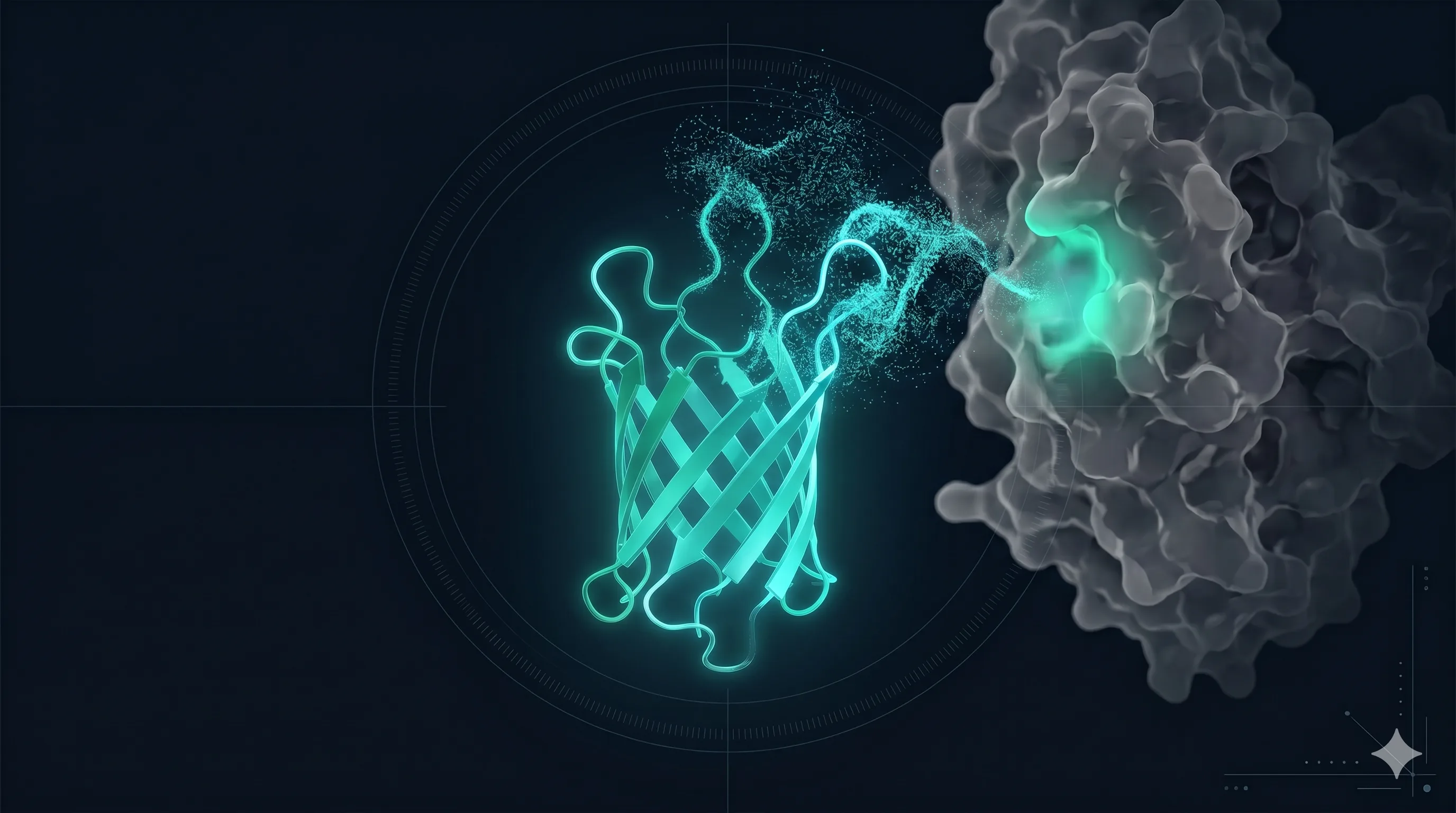
RFantibody for de novo nanobody (VHH) design
RFantibody is an antibody-finetuned RFdiffusion model. Hold a nanobody framework fixed, diffuse the heavy-chain CDR loops against your target structure with specified hotspots, and recover sequences via ProteinMPNN. Designs are filtered with an antibody-finetuned RoseTTAFold2 (RF2) before any wet-lab spend.
Self-serve through the Ranomics tools hub. No phage panning, no llama immunization, no starting from scratch.
Used by antibody discovery teams, academic immunology labs, and biotechs building VHH nanobody pipelines without starting from a phage panning campaign.
From target structure to filtered nanobody designs
Target and hotspots
Upload your antigen PDB and specify the hotspot residues that define the binding epitope. Use Epitope Scout upstream if you need help picking them.
CDR scope
Set CDR loop length ranges for the heavy-chain loops (H1, H2, H3) diffused onto the nanobody framework. H3 is the dominant lever on diversity.
Diffuse and design
RFantibody diffuses CDR backbones against the target while the framework stays fixed. ProteinMPNN designs sequences on each backbone.
RF2 filtering
Antibody-finetuned RoseTTAFold2 re-predicts each design in complex with the target. Top-ranked designs are returned with structures and scores.
An antibody-specific diffusion stack
RFantibody is not a generic binder model with antibody priors. The diffusion weights, the sequence designer, and the filter are all retrained on antibody-target complexes. Each stage is constrained to preserve immunoglobulin geometry.
Antibody-finetuned RFdiffusion
RFdiffusion weights finetuned on the antibody-antigen complex set from SAbDab. The framework stays fixed; only CDR coordinates are diffused, so the resulting scaffold remains a valid single-domain antibody.
Fixed nanobody framework
The hosted tool designs single-domain antibodies (VHH, nanobodies). It holds a nanobody framework fixed and diffuses only the heavy-chain CDR loops, so every output is a valid VHH ready for downstream humanization.
Configurable loop diffusion
Set per-CDR length ranges explicitly. A typical VHH run diffuses H1, H2, and H3 with length sampling across the ranges you choose. CDR-H3 length is the dominant lever on diversity.
ProteinMPNN sequence recovery
Sequences are generated for each diffused backbone with ProteinMPNN. Framework positions are conditioned on the input scaffold; the heavy-chain CDR positions are designed freely.
Antibody-finetuned RoseTTAFold2
Each design is re-predicted in complex with the target by an antibody-tuned RF2. Predictions that fail to recover the diffused binding mode are filtered out before any wet-lab handoff.
Context that shapes how a design ships
The single-domain advantage
A VHH is a single domain of roughly 15 kDa with no light chain to pair. That makes it easy to express in yeast or bacteria, quick to screen by display, and simple to build into multivalent or bispecific formats later.
VHH-Fc and humanization
A validated VHH can be fused to an Fc for avidity and half-life, or humanized against its closest human VH germline. The framework you design on determines how much humanization the final molecule needs.
Developability flags
CDR diversity often produces designs with exposed hydrophobic patches, unpaired cysteines, or N-glycosylation motifs. Run Developability Scout on shortlisted candidates before ordering a synthesis pool.
When nanobody design beats generic binder design
Generic binder models (RFdiffusion, BindCraft, BoltzGen) generate de novo mini-protein scaffolds. These are small, stable, and effective at engaging a target, but not antibodies. They cannot be reformatted to an antibody, are not humanizable, and inherit none of the manufacturing and regulatory infrastructure built around immunoglobulins.
RFantibody returns a real VHH nanobody. The scaffold is an antibody by construction, so downstream developability, affinity maturation, and humanization all use existing antibody workflows. Use it when the deliverable has to be a nanobody.
Designing VHHs against a structurally defined antigen without running a phage or yeast panning campaign
Building a nanobody for a multivalent or bispecific format where a small single domain is the advantage
Targeting an epitope that natural antibody repertoires have not seen, such as viral conserved sites, intracellular targets, or neoepitopes
Replacing a llama or alpaca immunization campaign on a target with a known structure
Generating diverse CDR-H3 paratopes against a defined hotspot for downstream affinity maturation
From in silico nanobody designs to validated binders
RFantibody returns a ranked list of designs. The next step is ordering, expressing, and screening them against the target. Two entry points depending on scope.
Validate a short list of VHH designs
The Binder Pilot is a short, fixed-scope campaign covering synthesis, yeast display screening, and ranked hits for a small nanobody design pool. Scoped for academic labs, seed biotech, and antibody discovery teams testing whether de novo VHH design works on their target.
See the Binder Pilot → Flagship programBuild an antibody pipeline on a deadline
The AI Binder Sprint is a multi-algorithm campaign over 6-8 weeks. RFantibody runs alongside RFdiffusion and BindCraft, with paired yeast display screening, NGS hit calling, and a 100% binder guarantee. For teams that need validated antibodies on a clock.
See the AI Binder Sprint →Start designing nanobodies today
Create an account, upload a target structure, configure your CDR scope. Get filtered VHH nanobody designs, ready for the wet lab.