
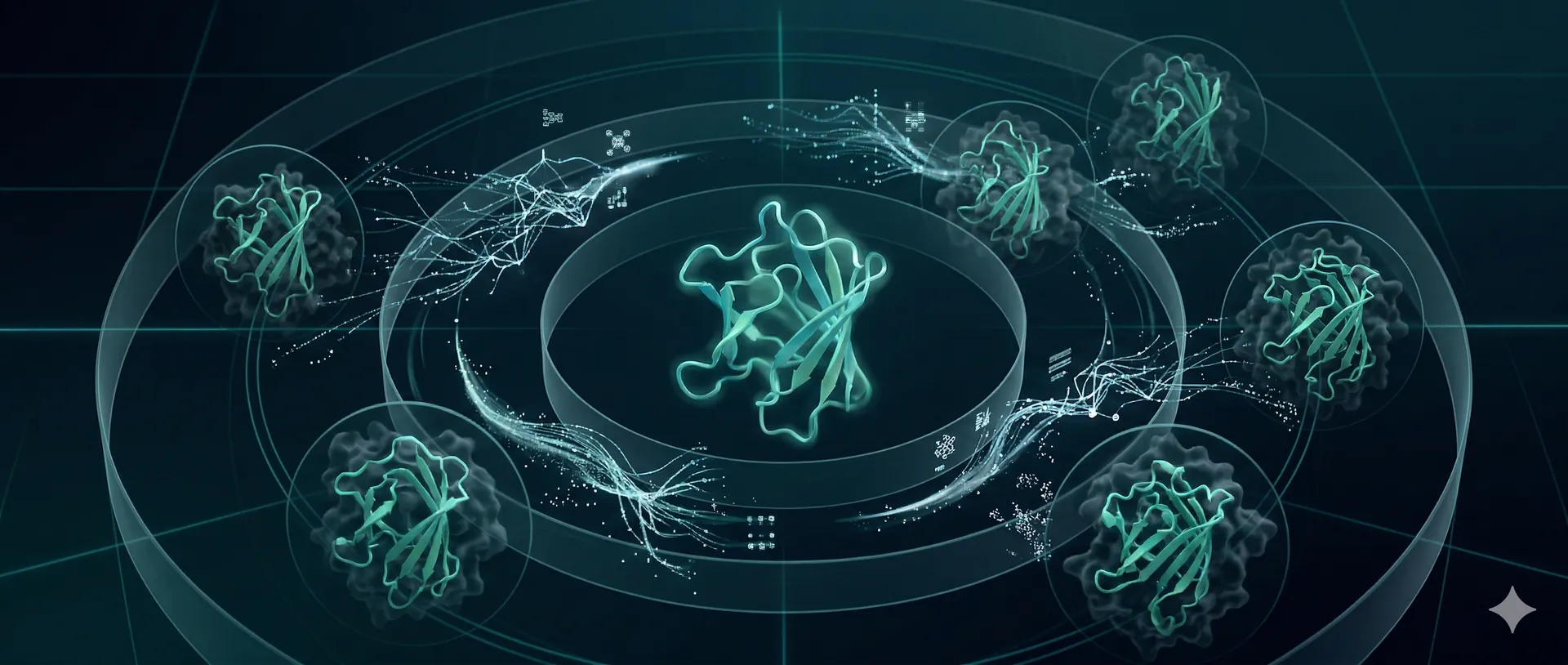
BindCraft AF2 binder design
Design de novo protein binders by backpropagating through AlphaFold2 multimer toward a chosen target surface. Upload a target PDB, specify hotspot residues, and BindCraft hallucinates sequences whose predicted folded structures bind exactly where you asked.
Best when you have a clean target structure plus literature or experimental hotspots. Produces fewer designs per run than RFdiffusion, with stronger per-candidate interface metrics.
Hosted self-serve through the Ranomics tools hub. No install, no scheduler, no queue management.
From target PDB to scored binder in one loop
Target plus hotspots
Upload a target PDB and specify hotspot residues. Leave hotspots blank to let AF2 select binding sites itself when no prior is available.
AF2 backpropagation
Gradient-based hallucination through AlphaFold2 multimer. Sequence logits are nudged toward outputs whose predicted complex binds the target at the masked hotspots.
Sequence convergence
Soft, temperature-softmax, hard one-hot, and greedy refinement phases drive the trajectory from a continuous distribution to a discrete designable sequence.
Multimer scoring
Candidates pass through MPNN resequencing, AF2 multimer validation, and interface scoring via FreeSASA and OpenMM. Accepted designs ship with ipTM, pLDDT, dG/dSASA, and contact maps.
Hallucinating binders through AlphaFold2
BindCraft is an AF2 hallucination method. It does not draw scaffolds from a diffusion prior or a library of native folds. Instead, it treats AlphaFold2 multimer as a differentiable function and asks: which sequence, when folded together with the target, is predicted to bind at these residues with high confidence? The pipeline answers that question through five tightly coupled components, drawn from Pacesa et al. (bioRxiv 2024).
Multimer scoring core
AlphaFold2 multimer evaluates the binder-target complex on every iteration. Losses combine ipTM at the interface, pLDDT on the binder, predicted aligned error across the interface, and explicit contact terms.
Gradient-based design
Sequence logits are updated by backpropagating through AF2 to minimize the multi-term loss. The trajectory moves from a continuous, soft distribution over amino acids toward a single discrete sequence.
Fixed-residue hotspot constraint
Hotspot residues are encoded as a fixed mask the loss rewards contact with. This is the geometric handle that distinguishes BindCraft from untargeted hallucination. The binder must engage these residues, not just the target somewhere.
ipTM and pLDDT thresholds
Trajectories that fail ipTM, pLDDT, contact-count, or interface metrics (shape complementarity and SASA) are dropped before reaching the output pool. The default thresholds reflect the empirical wet-lab hit-rate inflection points from the paper.
Iterative refinement loop
Each accepted backbone is reseasoned through ProteinMPNN, refolded with AF2, and rescored. The loop closes only when scaffold and sequence agree, eliminating the silent disagreements common in diffusion-then-sequence pipelines.
How BindCraft fits next to RFdiffusion
When BindCraft outperforms
BindCraft shines when hotspots are specific and the target is AF2-tractable, meaning soluble, well-folded, and present in the AF2 training distribution. The hotspot mask gives you a precise geometric handle that diffusion-based generators express only weakly. For receptor-blocking or epitope-specific campaigns, the fixed-residue constraint is the right primitive.
Quality over volume
BindCraft trades raw candidate volume for per-candidate quality. A typical run produces 500-2,000 designs, compared to RFdiffusion's tens of thousands of backbones. Pacesa et al. report that BindCraft candidates pass downstream structural validation at a higher rate than diffusion-only outputs, so the smaller pool concentrates the design budget on plausible hits.
No separate MPNN pass needed
BindCraft co-optimizes scaffold and sequence inside the AF2 loop. Sequences exit the pipeline already AF2-consistent with their backbones. No detached ProteinMPNN re-design step, no silent backbone-sequence disagreement to chase. ProteinMPNN is still available as an optional resequencing pass for diversification, but it is not a structural prerequisite the way it is for RFdiffusion outputs.
Pick the right generator for the campaign
BindCraft is one of three de novo binder generators Ranomics runs. The choice is not cosmetic. Each generator explores a different region of design space, and matching the generator to the target biology directly affects the final hit rate at the bench.
Reach for BindCraft when you have a known target structure, defined hotspots, and a need for higher per-candidate quality. Reach for RFdiffusion when you need broad topological exploration. Reach for RFantibody when the binder must specifically be a nanobody (VHH).
You have a target PDB plus literature or DMS-derived hotspot residues
You need a specific binding mode such as receptor-blocking, allosteric site, or epitope-specific
The target is well-folded and present in the AF2 training distribution
Per-candidate quality matters more than raw candidate volume
You are running a multi-generator campaign and want diverse design philosophies
You want sequence and scaffold to be AF2-consistent without a separate MPNN pass
From designed binders to validated leads
Generating BindCraft designs is the design layer. Validating them in cells is where the CRO ladder begins: synthesis, expression, yeast display sorting, and ranked hits. Two entry points depending on scope.
Validate a single round of BindCraft designs
The Binder Pilot is a short, fixed-scope de novo campaign with one round of design, ranked hits, and a technical report. Scoped for academic labs, seed biotech, industrial SMBs, and student research groups already running BindCraft self-serve and wanting wet-lab validation.
See the Binder Pilot → Flagship programRun BindCraft, RFdiffusion, and Boltzgen in parallel
The AI Binder Sprint runs BindCraft alongside RFdiffusion and Boltzgen over 6-8 weeks with milestone check-ins and a 100% binder guarantee. For teams building a binder pipeline on a hard deadline who want diverse design philosophies pooled into one screening cohort.
See the AI Binder Sprint →Launch a BindCraft run today
Sign in to the Ranomics tools hub, upload your target PDB, mark your hotspots, and launch a run. Ranked BindCraft designs with calibrated AF2 confidence delivered self-serve.