
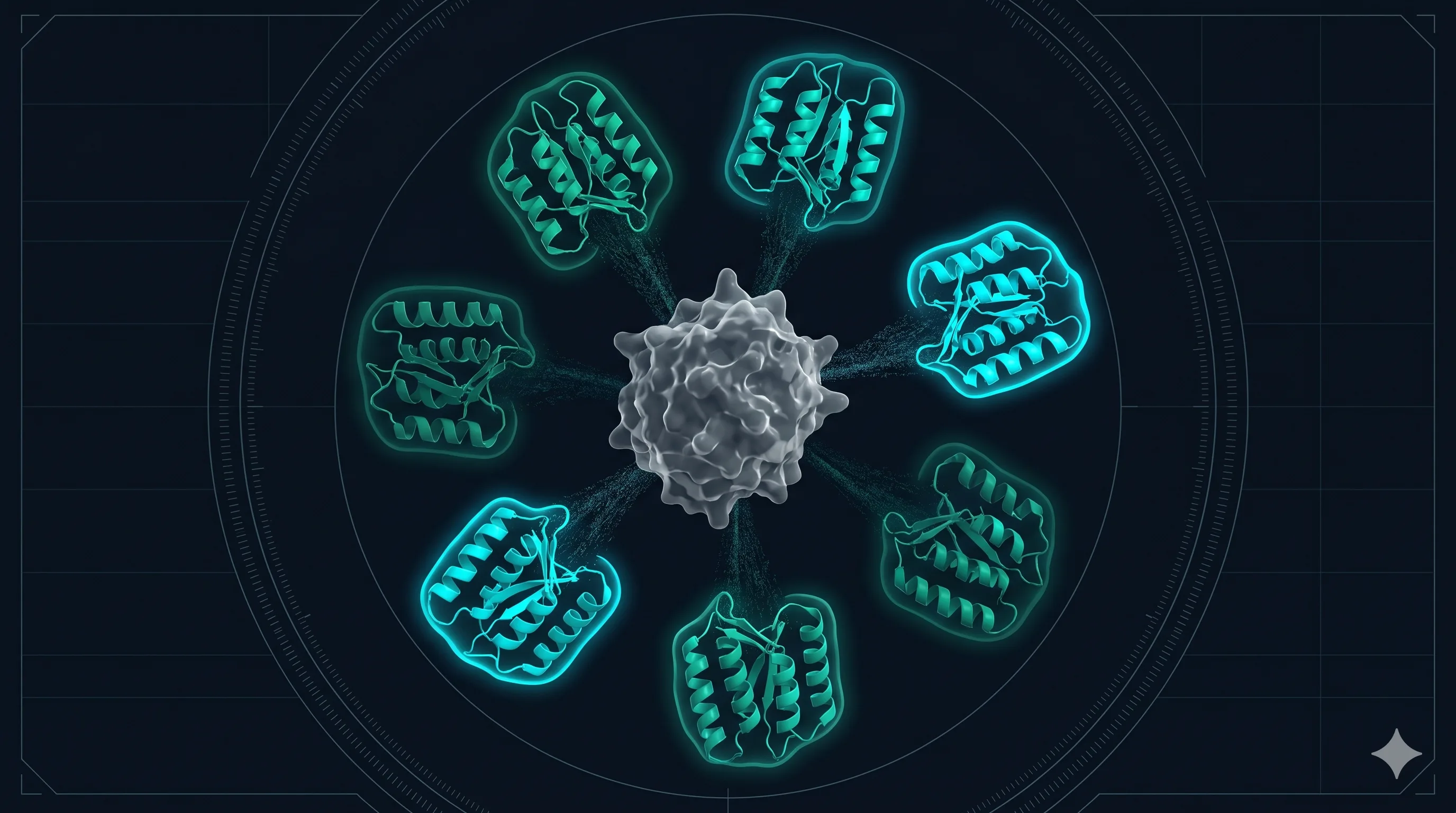
PXDesign: what it does and how to run it
PXDesign is ByteDance's open-source de novo binder design tool. It generates backbones with the AlphaFold3-class Protenix model, designs sequences with ProteinMPNN, and ranks every candidate by refolding the complex against your target with AlphaFold2 Initial Guess.
That last stage is what it is good at. Initial Guess seeds the model with the designed structure instead of predicting the complex from scratch, which is more discriminative on sequences no model has seen before. What comes back is a ranked CSV and a PDB per design, not raw output to triage yourself.
You can run it here, in a browser, on a hosted GPU with no install and no local CUDA. Ranomics runs the same pipeline on its own paid wet-lab campaigns, so the candidates you generate come out in the format we hand to the bench.
PXDesign (ByteDance, bioRxiv 2025), built on the Protenix AlphaFold3 reproduction. Designs are ranked with AlphaFold2 Initial Guess (Bennett et al., 2023).
Target structure to ranked binder candidates
Define hotspots
Upload a target PDB or AlphaFold model. Specify hotspot residues that the designed binder must contact, or pull them from Epitope Scout output.
Generate backbones
PXDesign's Protenix-based diffusion generator produces hundreds to thousands of novel scaffolds geometrically complementary to the hotspot patch.
Design sequences
ProteinMPNN assigns sequences to each backbone, with fixed positions at predicted contact residues to preserve binding geometry.
Score and rank
AlphaFold2 Initial Guess and Protenix confidence refold each binder-target complex and rank on interface pLDDT, PAE, and ipTM. Ranked CSV plus PDBs delivered.
Four stages, one integrated run
PXDesign is ByteDance's open-source pipeline, built on their AlphaFold3-class Protenix model. It chains the canonical stages of modern de novo binder design into one integrated run, with each stage passing its outputs directly to the next and no manual handoff between tools.
Backbone generation
Protenix-based diffusion. PXDesign's generator, built on ByteDance's AlphaFold3-class Protenix model, reverses a noise process to produce backbone coordinates geometrically complementary to the specified epitope. Scaffold length range and topology constraints are tunable per run.
ProteinMPNN sequences
Inverse-folding sequence design. Multiple sequences sampled per backbone at controllable temperature, with hotspot contact positions fixed to preserve the diffusion-defined binding geometry.
AlphaFold2 Initial Guess
AlphaFold2 multimer refolds each binder-target complex using the designed structure as the initial coordinate guess. This is faster and more discriminative than de novo AF2 multimer prediction, and PXDesign combines it with Protenix confidence to rank designs.
Interface filtering
Candidates are ranked on interface pLDDT, PAE at the predicted interface, and ipTM. Designs whose refold matches the original geometry rise to the top; designs that drift are discarded.
Ranked candidate set
CSV of scored designs plus per-candidate PDB structures. Top candidates are pre-formatted for direct handoff into a Ranomics wet-lab Binder Pilot or AI Binder Sprint.
Why running PXDesign is not the same as downloading it
Current-generation scoring
PXDesign scores with AlphaFold2 Initial Guess and Protenix confidence rather than default AF2 multimer, which is slow and noisy when the binder is a never-seen-before designed sequence. Initial Guess seeds the model with the designed structure and asks whether it agrees the complex is real. The result is faster scoring and a success metric that tracks wet-lab binding more tightly than default multimer scores.
Wet-lab feedback loop
We run PXDesign on real campaigns and see which designs actually bind, so we know its true hit rate and where it fails. That feedback tunes how we use it: filter thresholds, scaffold length ranges, hotspot weighting, and which tool fits which target. You launch it with the settings we learned from real yeast display screens, not defaults out of the box.
Scales to full campaigns
Self-serve PXDesign runs on the same infrastructure we use internally. Hundreds of candidates per run. Need 10,000 to 50,000 designs across a full campaign? The same pipeline scales up inside an AI Binder Sprint with no rewrite and no re-validation.
The tool we reach for first on paid campaigns
PXDesign is current-generation. Its generator is built on Protenix, an AlphaFold3-class model, and the PXDesign benchmark reports experimental hit rates of 17 to 82 percent nanomolar binders across most targets tested. We run it, we know its real hit rate, and the Initial Guess scoring step is what makes us willing to put a 100% binder guarantee on the AI Binder Sprint.
Run it self-serve when you want the same tool Ranomics uses internally, with results in a format that drops straight into a wet-lab campaign if the candidates are worth testing.
You want the same de novo binder tool Ranomics runs on its own paid wet-lab campaigns
Comparing AlphaFold2 Initial Guess scoring against your existing RFdiffusion plus default AF2 multimer pipeline
Need ranked binder candidates against a target you already have a PDB or AlphaFold model for
Planning a Binder Pilot or AI Binder Sprint and want to scope the design space before paying for wet-lab validation
Running an internal feasibility study before committing budget to a multi-week campaign
Tuning hotspot residue selection from Epitope Scout output and want to see which patches generate scoreable designs
From ranked candidates to validated binders
PXDesign gives you scored, ranked binder candidates. The next step is putting the top hits on cells and seeing which ones actually bind. Two entry points depending on scope, both running the same PXDesign pipeline on the wet-lab side as you just ran self-serve.
Validate your PXDesign candidates in cells
The Binder Pilot takes your top PXDesign hits, expresses them on yeast display, and sorts for target binding. Single-round, ranked hits, technical report. Scoped for academic labs, seed biotech, industrial SMBs, and student research groups.
See the Binder Pilot → Flagship programRun PXDesign at full campaign scale
The AI Binder Sprint runs PXDesign alongside RFdiffusion, BindCraft, and BoltzGen at 10,000 to 50,000 designs over 6-8 weeks, with milestone check-ins and a 100% binder guarantee. For teams building a binder pipeline on a hard deadline.
See the AI Binder Sprint →Run the tool we run on our own campaigns
Sign in, upload a target structure, define hotspots. Get ranked binder candidates scored with AlphaFold2 Initial Guess.
PXDesign (ByteDance, bioRxiv 2025), built on the Protenix AlphaFold3 reproduction. Designs ranked with AlphaFold2 Initial Guess: Bennett, J. et al. Improving de novo protein binder design with deep learning. Nature Communications 14, 2625 (2023). See all Ranomics technology.