
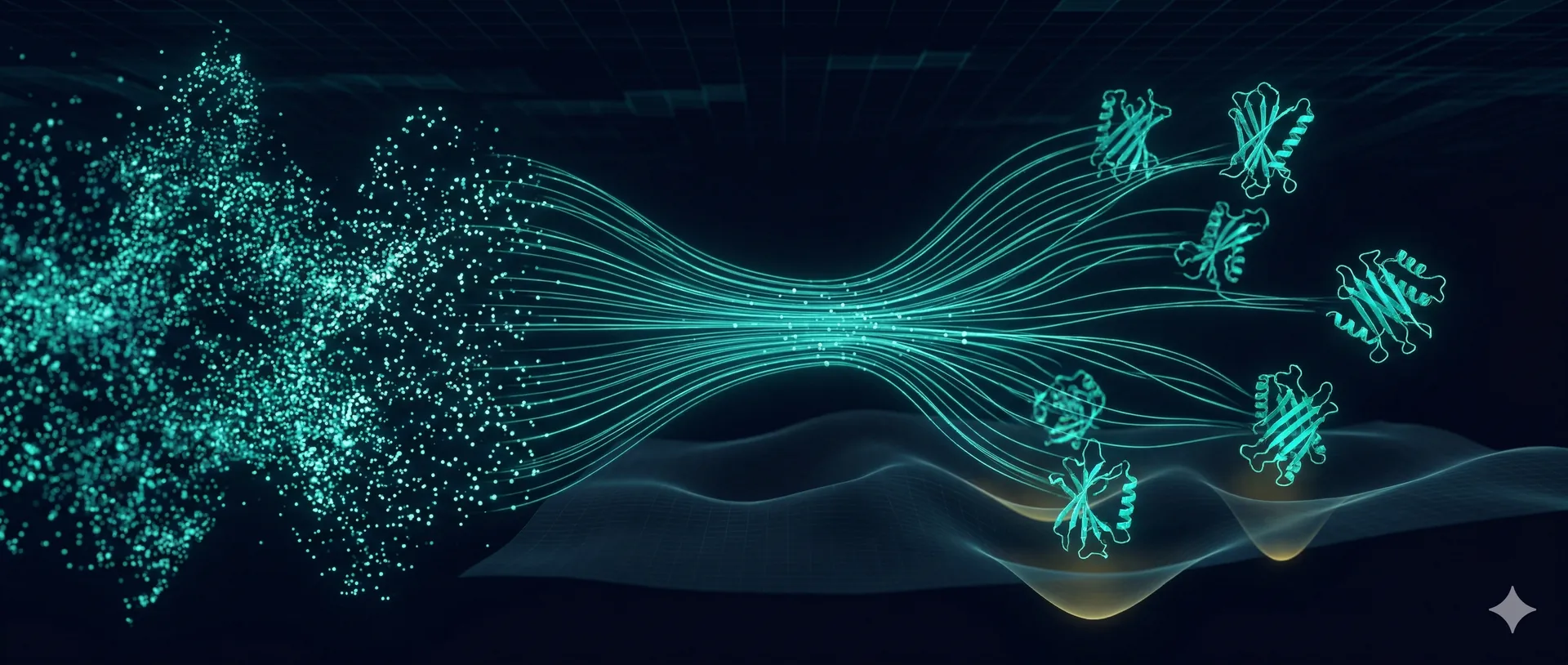
BoltzGen all-atom de novo binder design
BoltzGen is an open-source all-atom generative diffusion model for de novo binder design from the MIT Jameel Clinic. It reasons over every atom of the binder it builds, not just the backbone, and each candidate is inverse-folded and refolded to check it holds the intended structure before it reaches you.
Hosted self-serve at tools.ranomics.com. Upload a target structure, mark the epitope hotspots, and get ranked binder candidates back.
One of several de novo binder generators on the platform. Run it on its own, or alongside RFdiffusion and BindCraft when you want maximum scaffold diversity.
From target structure to refolded binder candidates
Define the target
Upload a PDB or mmCIF of your target chain and mark the hotspot residues that define the epitope. Use Epitope Scout upstream if you need help choosing them.
BoltzGen generation
The all-atom diffusion model samples binder candidates against the target and hotspots, reasoning over side-chain atoms during design rather than the backbone alone.
Inverse-fold and refold
Each design is inverse-folded to a sequence, then refolded and scored for self-consistency on refolding RMSD, ipTM, and pLDDT. Designs that do not refold to the intended complex are flagged.
Ranked candidates
Top designs returned with confidence metrics, designed sequence, and a PDB of the predicted complex. Ready for ProteinMPNN refinement, yeast display validation, or downstream wet-lab handoff.
One open pipeline, generation and self-consistency validation
BoltzGen is an open-source all-atom generative diffusion model for universal binder design from the MIT Jameel Clinic (Stärk et al., 2025), released under an MIT license. Its bundled pipeline inverse-folds and refolds every design to check structural self-consistency before handoff.
All-atom diffusion generator
BoltzGen is an all-atom generative diffusion model trained to design binders directly against a biomolecular target. Because it reasons over side-chain atoms and not just the protein backbone, it packs the interface during generation rather than deferring every sequence choice to a later step. Open weights, MIT license.
Direct binder generation
BoltzGen generates binder candidates conditioned on the target structure and your specified hotspots, sampling backbone and sequence together rather than diffusing a bare backbone first.
Inverse folding
Each generated design is inverse-folded to an amino acid sequence with BoltzGen's own inverse-folding module. An optional ProteinMPNN pass can re-design sequences downstream.
Refolding self-consistency
Every design is refolded from its sequence and compared to the generated complex. Refolding RMSD, ipTM, and pLDDT flag designs that do not reconstitute the intended binding mode.
Open and self-serve
BoltzGen runs self-serve on Ranomics GPU compute, no local install. The same open weights and pipeline the MIT Jameel Clinic released, hosted so you can run it on your target from a browser.
Where an all-atom generator fits
All-atom generation
BoltzGen packs side chains at the interface as it designs, so the sequence and the backbone are chosen together. That is a different design path from backbone-first tools that hand sequence design to a separate step.
Run it in parallel
No single generator wins on every target. BoltzGen runs alongside RFdiffusion and BindCraft in our campaigns, and the yeast display screen decides which designs actually bind. Diversity across generators is the point.
Open and reproducible
BoltzGen and its pipeline are open source under an MIT license. What runs on the platform is the released model, so a result is reproducible outside our walls.
A complementary generator in a multi-tool campaign
For most de novo binder work, BoltzGen, RFdiffusion, and BindCraft are complementary generators, and the right move is to run more than one and let the assay decide. BoltzGen is a strong pick when you want an all-atom generator that chooses backbone and sequence together.
Run it alongside RFdiffusion and BindCraft for maximum diversity on a hard target, or on its own for a fast de novo pass against a structurally defined epitope.
De novo binders against a structurally defined target with known hotspots
A fast first pass to see whether a target is designable before committing to a multi-tool campaign
Adding generator diversity to an RFdiffusion or BindCraft pool before pooled screening
Targets where you want the sequence chosen during backbone generation rather than in a separate step
Any de novo binder shortlist headed for yeast display validation
From in-silico binders to validated hits in cells
BoltzGen returns a ranked list of designed binder sequences with predicted complex structures. The next step is wet-lab validation in yeast display, where binding is measured, not predicted.
Validate a shortlist of BoltzGen designs
The Binder Pilot is a single-round, fixed-scope de novo binder campaign. Bring a BoltzGen candidate pool, we screen it against your target in yeast display and return ranked hits with a technical report. Scoped for academic labs, seed biotech, industrial SMBs.
See the Binder Pilot → Flagship programMulti-tool binder campaign on a deadline
The AI Binder Sprint runs BoltzGen alongside RFdiffusion and BindCraft over 6 to 8 weeks with milestone check-ins and a 100% binder guarantee. The right scope when the target is hard and you need a binder on a clock.
See the AI Binder Sprint →Design de novo binders against your target
Create a free tools.ranomics.com account and run BoltzGen on a structurally defined target. Ranked, refolded candidates ready for handoff.