
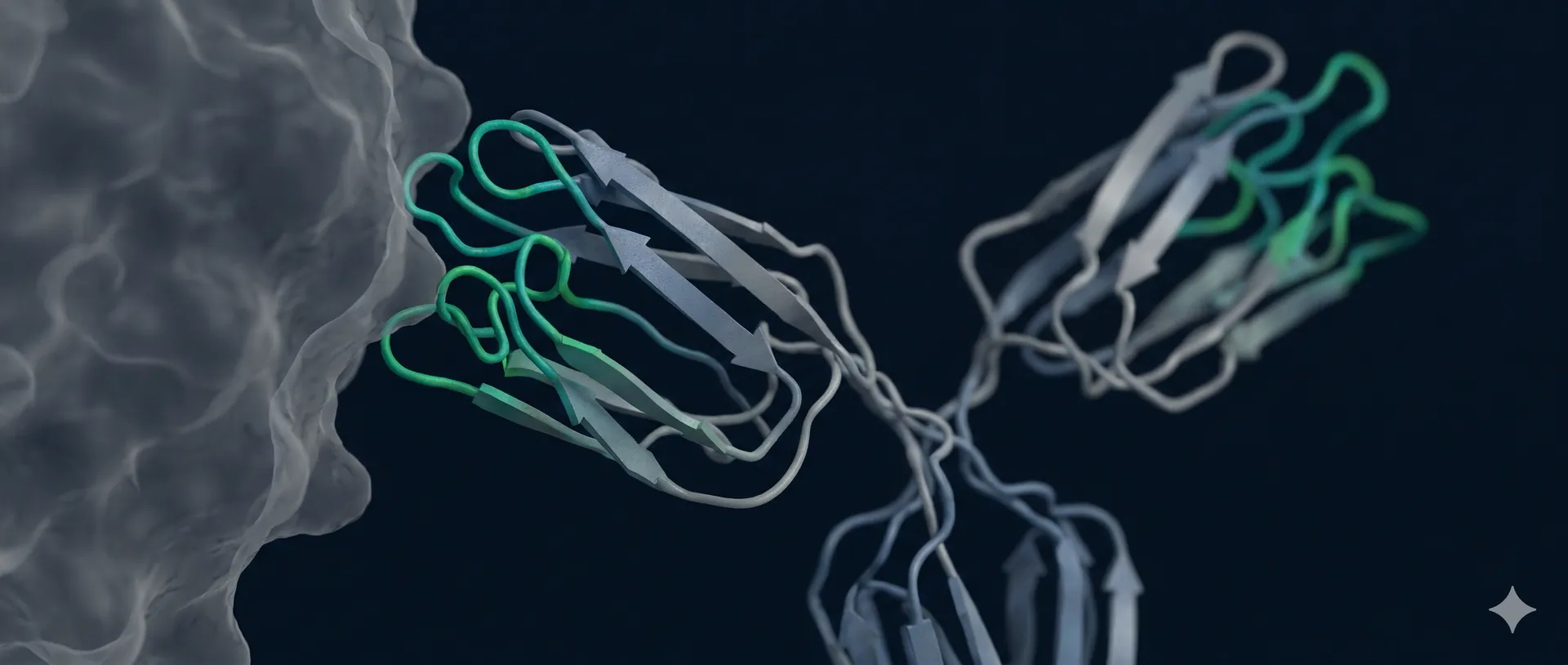
ESMFold2 design for scFvs and minibinders
Gradient-based binder design through ESMFold2 inversion. One model designs all six CDRs on a locked humanized antibody framework, or generates a de novo minibinder backbone-plus-sequence in a single optimization pass.
Validated against PDGFRB, EGFR, PD-L1, CD45, and CTLA4 in laboratory assays, with BLI-measured affinities from 68 pM to 70 nM across both modalities.
The only tool in the catalog that designs paired heavy-and-light scFv CDRs end-to-end on a humanized framework.
From target to ranked binder candidates in one model
Target and mode
Pick a paper-validated target preset (CTLA4, EGFR, PD-L1, CD45, PDGFRB) or paste your own sequence. Choose minibinder mode or scFv mode with one of three humanized frameworks.
Soft sequence initialization
A soft logits tensor over the 20 amino acids initializes the mutable positions. For scFv mode, all six CDRs are mutable on a locked framework backbone.
ESMFold2 inversion
150 gradient steps backpropagate through ESMFold2 to minimize a contact-and-binding loss. Sequence and predicted structure are optimized jointly. No separate sequence-design stage.
Critic scoring and ranking
Hero critics with confidence heads score each design by iPTM and a distogram iPTM proxy, and a results row takes both numbers from one of them. Designs rank by iPTM, and the page puts forward the highest-ranked design in the best tier it has, labelling that pick when it did not clear the quality bar for that mode.
What ESMFold2 inversion actually does
ESMFold2 is a sequence-to-structure prediction model trained on a substantially larger corpus than earlier folders. Inversion runs the same network in reverse: gradient descent on a soft sequence representation, backpropagated through the structure prediction graph, jointly optimizes the sequence and its predicted binding pose. Chan Zuckerberg Biohub demonstrated wet-lab binders against five therapeutically relevant targets, validated by laboratory assays in the Biohub 2026 ESMFold2 paper, built on the ESMC protein language model.
Inversion of ESMFold2
The same network that predicts structure now optimizes sequence by gradient descent. One model end-to-end. No separate ProteinMPNN sequence-design stage.
150 gradient steps
Soft sequence logits annealed by sigmoid temperature schedule. Learning rate 0.1. Cysteines suppressed by default to avoid spurious disulfides in scaffolds.
Framework-locked CDR design
For scFv mode only the six CDR regions are mutable. Framework backbones are fixed sequence and structure. Three humanized frameworks: trastuzumab, atezolizumab, ocankitug.
Minibinder generation
For minibinder mode a free 60 to 200 aa scaffold is generated. An isoelectric-point filter (pI below 6) is applied at output for downstream displayability on yeast or mammalian platforms.
Critic scoring
The iPTM and the distogram proxy on a results row come from the same critic, ESMFold2-Experimental-Cutoff2025, rather than from two models. Only the iPTM is calibrated; the proxy is informative, and it is what the scFv quality gate reads. The minibinder gate reads iPTM together with the pI filter.
A scFv-first slot the rest of the catalog does not fill
scFv as a first-class output
Most binder-design pipelines output single-domain backbones that you then graft, humanize, and reformat. ESMFold2 design produces a complete heavy plus light scFv with all six CDRs designed against the target, on a humanized framework. Drop into yeast display or mammalian display directly.
Comparison with BindCraft
Both invert a fold model via gradient descent. BindCraft uses AF2 multimer. ESMFold2 design uses ESMFold2, trained on a substantially larger corpus and faster per step. Different speed and diversity tradeoff. Run both for orthogonal candidate pools.
Comparison with RFantibody
RFantibody produces VHH single-domain nanobodies, a camelid format. ESMFold2 design produces scFvs with heavy and light variable domains on a flexible linker, targeting workflows that need a humanized format. The two tools cover different antibody modalities.
The fastest path from target to a scFv candidate pool
The Biohub 2026 ESMFold2 paper confirmed binding against PDGFRB, EGFR, PD-L1, CD45, and CTLA4 in both minibinder and scFv modalities, with BLI-measured affinities from 68 pM to 70 nM. Reported hit rates run 36 to 88 percent for minibinders and 15 to 29 percent for scFvs in the higher-compute cohorts. The designed PD-L1 binders restored signaling dose-dependently, at functional IC50 values of 1.6 nM for the minibinder and 39 nM for the scFv. The five targets cover receptor tyrosine kinases, immune checkpoints, and cell-surface phosphatases. Each is shipped as a preset so you can baseline your screening setup on a target with published results.
On the Ranomics tools hub it runs self-serve on a dedicated H100, with no shared batch queue between you and your designs.
Designing a scFv against a soluble target with all six CDRs co-optimized in one inversion pass
Comparing CDR designs across the three validated humanized frameworks (trastuzumab, atezolizumab, ocankitug)
Generating de novo minibinder candidates as a gradient-based alternative to RFdiffusion diffusion sampling
Sweeping seeds across a target to build a 128-design candidate library
Re-engaging a target that failed under RFdiffusion plus ProteinMPNN plus AF2. A different fold prior often surfaces different binders.
Drop-in scoring against the five paper-validated targets to baseline your wet-lab setup before committing to a campaign
From designed scFvs to validated hits
Self-serve ESMFold2 design gives you the design layer. Turning ranked candidates into validated wet-lab hits needs synthesis, display, sorting, and NGS. Two entry points depending on scope.
Validate ESMFold2-design hits in the wet lab
The Binder Pilot is a short, fixed-scope de novo binder campaign with one round of design, ranked hits, and a technical report. Scoped for academic labs, seed biotech, industrial SMBs, and student research groups. Soft contracting under mutual NDA and MTA.
See the Binder Pilot → Flagship programMulti-algorithm binder campaign
The AI Binder Sprint runs ESMFold2 design alongside RFdiffusion, BindCraft, and BoltzGen over 6 to 8 weeks with milestone check-ins and display-validated hits. For teams building a binder pipeline on a hard deadline.
See the AI Binder Sprint →Launch an ESMFold2-design run today
Sign in to the Ranomics tools hub, pick a target preset or paste your sequence, choose minibinder or scFv mode, and submit. Get back ranked binder candidates with iPTM confidence scores in one model.