
Run RFdiffusion for binder design without a local GPU
Run RFdiffusion in the browser: no CUDA install, no conda environment, no cluster time. Hotspot-conditioned de novo backbone generation, paired with ProteinMPNN sequence design and AlphaFold2 multimer scoring in the same run. The most widely cited de novo protein design tool, hosted self-serve.
Calibrated AF2 confidence thresholds so you know which designs are worth ordering.
Used by academic labs, biotech startups, and independent protein designers as the front-end of de novo binder discovery campaigns.
From target structure to ranked binder candidates, with no GPU of your own
Target plus hotspots
Upload a target PDB and specify hotspot residues. Hotspots come from Epitope Scout, literature alanine scans, or interface analysis on a co-crystal.
Backbone generation
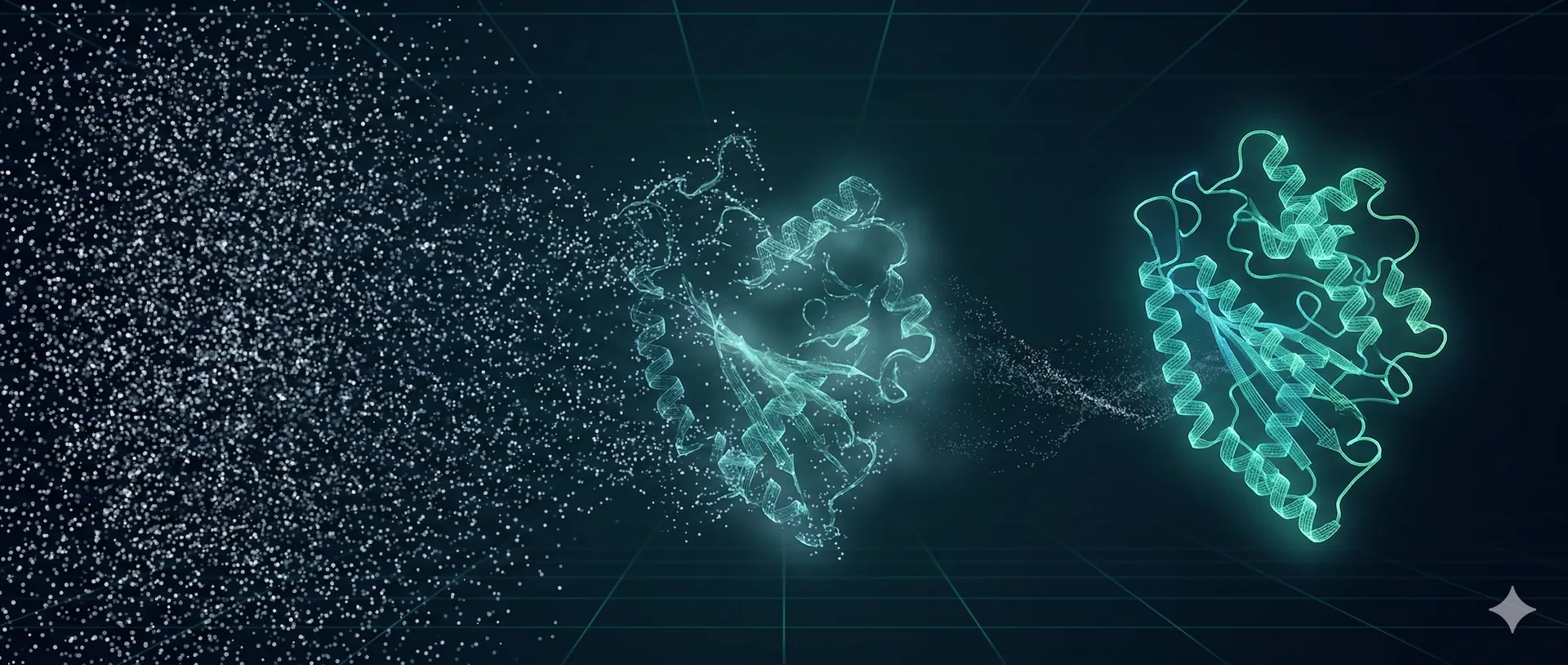
RFdiffusion denoises Gaussian noise into protein backbones constrained to contact the hotspot residues. Scaffolds typically 60 to 150 residues.
Sequence design
ProteinMPNN assigns an amino acid sequence to each generated backbone. Multiple sequences per scaffold expand the candidate pool.
AF2 multimer scoring
AlphaFold2 multimer refolds each binder plus target complex. Calibrated pAE, pLDDT, and iPTM thresholds rank designs ready for synthesis.
How RFdiffusion works: denoising diffusion over backbone coordinates
RFdiffusion is a fine-tuned RoseTTAFold structure prediction network repurposed as a denoising diffusion generative model. Trained on the Protein Data Bank, it learns to reverse a forward noise process and generate physically plausible backbone coordinates. Watson et al., Nature 2023, demonstrated wet-lab binders against multiple disease targets validated by crystallography and cryo-EM.
RoseTTAFold diffusion
A pretrained RoseTTAFold structure prediction network fine-tuned to predict the clean backbone at every step of a noise schedule. Inherits structural priors from the PDB without explicitly searching it.
Iterative steps
Generation starts from random coordinates and runs 50 to 200 denoising steps. Each step refines the backbone toward a coherent fold while honoring target conditioning.
Motif scaffolding
Hold a functional motif fixed and design the surrounding scaffold around it. Used for enzyme active sites, viral immunogens, and grafting binding loops onto novel folds.
Binder design
Specify target plus hotspot residues and RFdiffusion generates a binder scaffold whose interface contacts those hotspots. The dominant mode for de novo binder discovery.
Partial diffusion
Start from an existing scaffold, partially noise it, and denoise back. Generates a diverse family of related designs for downstream MPNN and AF2 ranking.
Context that shapes a design campaign
Binder vs scaffolding modes
Binder design conditions on a target structure and hotspot residues to grow a new scaffold that engages the surface. Motif scaffolding conditions on a fixed functional motif and designs the surrounding fold. Same model, different conditioning channels.
Integrated downstream pipeline
RFdiffusion backbones flow directly into ProteinMPNN for sequence design and AlphaFold2 multimer for complex refolding. Calibrated pAE and iPTM cutoffs filter the candidate pool to a ranked, synthesis-ready shortlist.
Comparison with BindCraft
BindCraft optimizes scaffold and sequence in a tightly coupled inner loop with backpropagation through AF2 multimer. RFdiffusion generates broadly first, then filters with MPNN and AF2 in a separate stage. Different speed and diversity tradeoffs.
The general-purpose entry point to de novo binder design
RFdiffusion is the most widely cited tool in this category and the default choice when you need broad scaffold diversity around a chosen hotspot. The Nature 2023 paper validated binders against IL-7Ra, PD-L1, TrkA, influenza HA, and other targets with crystallographic confirmation, establishing diffusion as a credible de novo design route.
On the Ranomics tools hub it runs self-serve, with no shared batch queue between you and your designs.
Designing de novo binders against a non-antibody target where you have a structure and validated hotspots
Exploring scaffold diversity for a target before narrowing to a focused BindCraft optimization run
Motif scaffolding by placing a functional motif into a novel fold for enzyme or immunogen design
Partial diffusion for design diversification, sampling a family of related backbones from a seed scaffold
Generating the input scaffold pool for a downstream ProteinMPNN plus AF2 multimer ranking pipeline
From designed binders to validated hits
Self-serve RFdiffusion gives you the design layer. Turning ranked candidates into validated wet-lab hits needs synthesis, display, sorting, and NGS. Two entry points depending on scope.
Validate RFdiffusion hits in the wet lab
The Binder Pilot is a short, fixed-scope de novo binder campaign with one round of design, ranked hits, and a technical report. Scoped for academic labs, seed biotech, industrial SMBs, and student research groups. Soft contracting under mutual NDA and MTA.
See the Binder Pilot → Flagship programMulti-algorithm binder campaign
The AI Binder Sprint runs RFdiffusion alongside BindCraft and BoltzGen over 6 to 8 weeks with milestone check-ins and a 100% binder guarantee. For teams building a binder pipeline on a hard deadline.
See the AI Binder Sprint →Launch an RFdiffusion run today
Sign in to the Ranomics tools hub, upload your target PDB, set hotspots, and submit. Get back ranked binder candidates with AF2 confidence scores.