
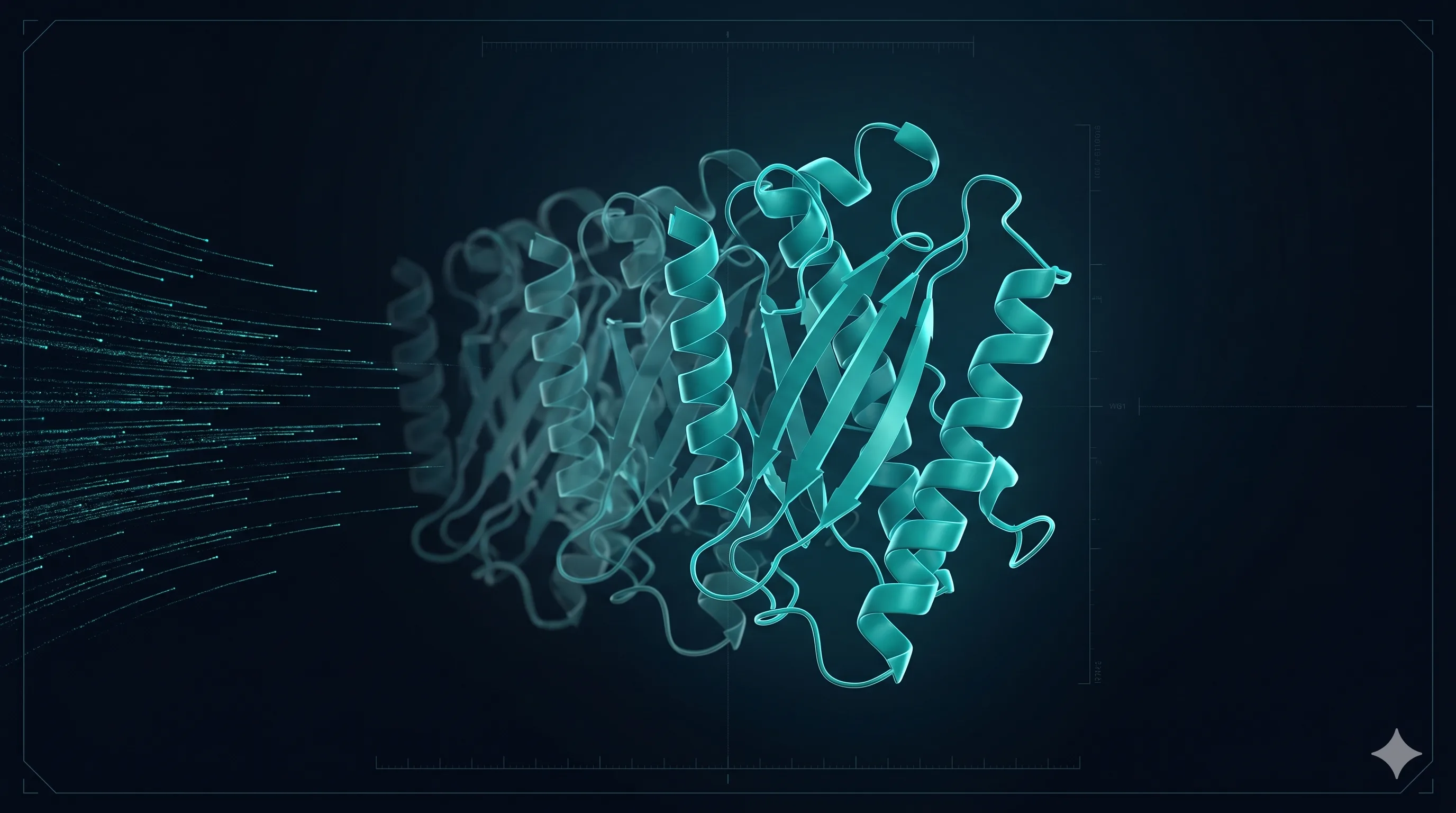
ColabFold fast protein structure prediction
The Ranomics ColabFold tool runs a fast single-sequence fold: AlphaFold2 weights with no MSA and no templates, built for high-throughput triage of designed binders and orphan sequences, where an MSA adds little. For MSA-based folding of natural proteins, use the AlphaFold2 tool.
Monomer or multimer, single-sequence speed, seconds per model. Per-residue pLDDT and PAE on every output.
Hosted at tools.ranomics.com. Funded from your wallet, with $5 free to start.
From sequence to folded model in one pass
Submit sequence
Paste a FASTA sequence or upload a multi-sequence file. Monomers run as-is; multimers use a colon to separate chains.
Single-sequence fold
The hosted tool folds from the query sequence alone, no MSA search. That is the speed win for designed and orphan sequences, which carry no meaningful evolutionary alignment anyway.
AF2 inference
Run the AlphaFold2 weights on the single sequence with configurable recycle iterations. No MSA and no templates by default.
Folded model
Download a ranked PDB ensemble with per-residue pLDDT, PAE matrices, and predicted TM-score for multimer interfaces.
What ColabFold changes inside the AF2 pipeline
The hosted ColabFold tool keeps the AlphaFold2 weights unchanged and skips the MSA search entirely, folding from the single query sequence. The throughput gain is the point: seconds per model for triaging large designed sets. When an MSA matters, the AlphaFold2 tool runs ColabFold with a full MMseqs2 search.
Single-sequence folding
The hosted tool runs colabfold_batch in single-sequence mode, no homology search. Fastest path to a fold when the sequence is designed or orphan and an MSA would add noise, not signal.
Complex prediction
Fold a monomer, or separate chains with a colon to predict a complex and get ipTM at the interface, all in single-sequence mode.
Per-residue confidence
pLDDT 0-100 per residue tells you which regions of the model to trust. PAE matrix tells you which inter-residue distances are confidently resolved.
Same AlphaFold2 network
Identical AlphaFold2 weights as the full pipeline. Only the MSA is dropped, so a good single-sequence fold is a genuine AF2 prediction, just faster and with less context.
Recycle iterations
Each recycle feeds the previous prediction back as input. Default 3, configurable up to 12, with diminishing returns past 6 for most targets.
Multimer, model choice, and batch throughput
Multimer mode
Predicts protein complexes using AF2-multimer weights or the residue-index-jump trick on the monomer model. Returns a predicted interface TM-score and pAE matrix so you can quantify confidence in the inter-chain contacts, not just the chain folds.
When to pick which fold
ColabFold for throughput on natural sequences with MSAs. Full-MSA AF2 for the final, highest-accuracy fold on a single chosen design. ESMFold for the fastest single-sequence pass on designed binders, orphan sequences, or anything where an MSA would not help.
Batch throughput
ColabFold is the throughput tool of choice for triaging large design pools. Fold an entire RFdiffusion or BindCraft output set in a single sitting, then promote the highest-confidence handful to full-MSA AF2 or wet-lab validation.
When speed beats the last decimal of accuracy
Full-MSA AlphaFold2 is the gold standard for a single, definitive structure. But most real campaigns generate hundreds or thousands of candidate sequences, and you cannot afford to fold them all with the slow path. ColabFold is the throughput tool that bridges the gap between sequence generation and final-model validation.
Use ColabFold to rank a design pool, screen mutants, or survey a target family. Promote the top handful to full-MSA AF2 or experimental validation.
Triaging a pool of designed binder sequences before committing to wet-lab validation
Folding all variants in a deep mutational scanning library to flag misfolded designs
Surveying a target protein family by folding all orthologs in a single pass
Running a design-validation pass on RFdiffusion, BindCraft, or BoltzGen outputs
Building a structural prior for downstream docking, MD, or interface analysis
Quick sanity-check folds where 1-2 angstrom accuracy is enough for the decision
Once a design folds, the question is whether it binds
A confident pLDDT model tells you the sequence can fold. It does not tell you it will bind your target, express in cells, or survive a sort. That is where wet-lab validation comes in.
Validate your top folded designs
The Binder Pilot takes your top ColabFold-ranked designs through a single-round yeast display campaign covering gene synthesis, expression, sorting, and a ranked hit list. Scoped for academic labs, seed biotech, industrial SMBs, and student research groups.
See the Binder Pilot → Flagship programMulti-round de novo program
The AI Binder Sprint is a multi-algorithm campaign (RFdiffusion, BindCraft, BoltzGen) over 6-8 weeks with milestone check-ins and a 100% binder guarantee. ColabFold sits in the in-silico triage loop, ESMFold sits next to it for single-sequence folds.
See the AI Binder Sprint →In-depth ColabFold guides
ColabFold vs AlphaFold 2: when to use which
Where the MMseqs2 frontend beats the full MSA pipeline, and where it does not.
ColabFold batch triage for binder designs
Using colabfold_batch to rank RFdiffusion and BindCraft pools by self-consistency before the bench.
Running ColabFold locally
LocalColabFold, the notebook, or a hosted GPU: choosing how to run colabfold_batch.
Fold your first sequence today
Create a free account on tools.ranomics.com and run ColabFold on a designed sequence. No shared queues, no install.
Method: Mirdita et al., ColabFold: making protein folding accessible to all. Nat Methods 19, 679-682 (2022). See also all Ranomics technology.