
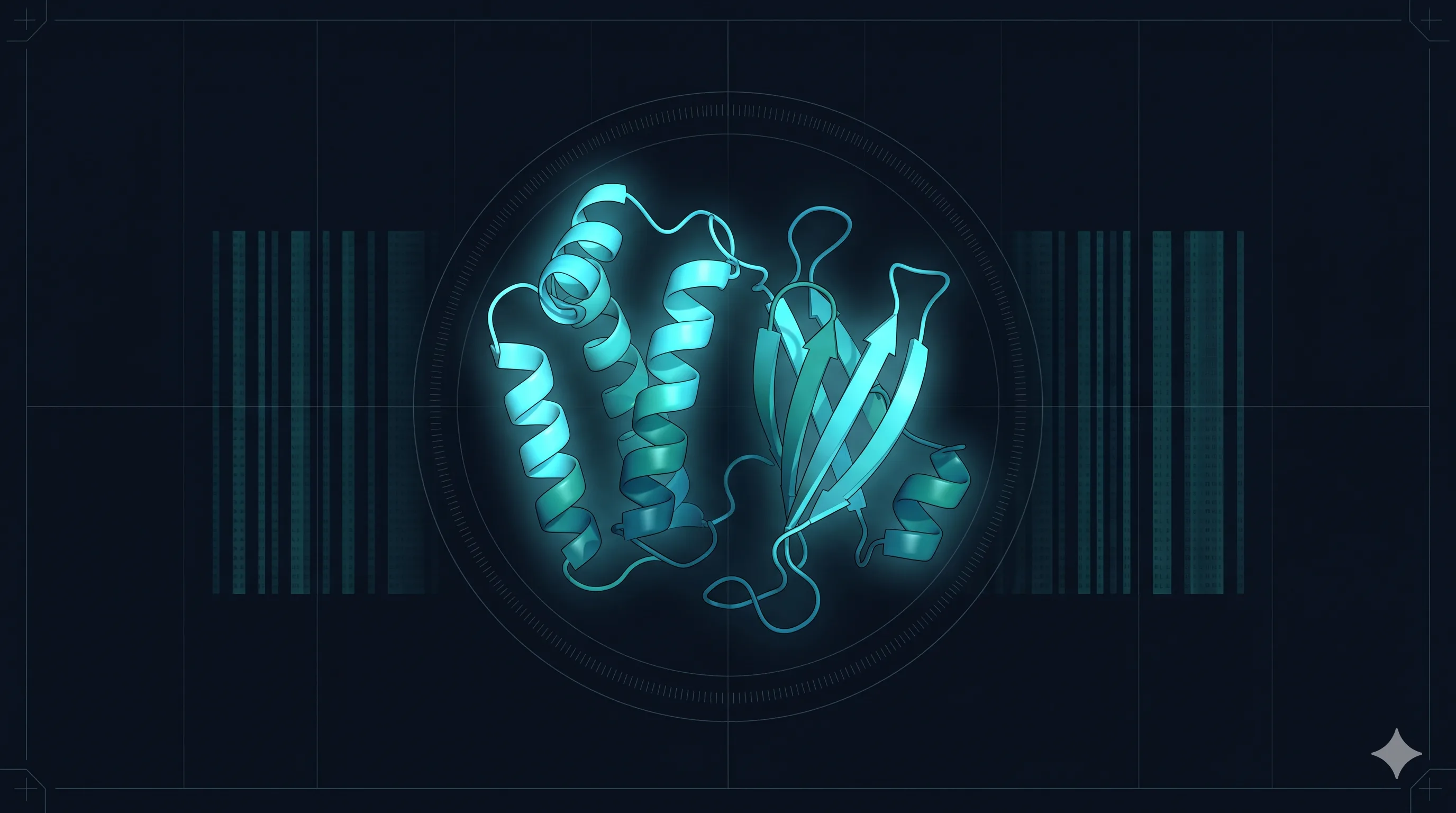
AlphaFold2 protein structure prediction
Gold-standard AlphaFold protein structure prediction with full multiple sequence alignment, structural templates, and calibrated per-residue pLDDT and pairwise PAE confidence. Run a monomer or switch to AF2 multimer for protein complexes with pTM and ipTM scores at the interface.
Hosted at tools.ranomics.com with no shared queues and no install. Funded from your wallet, with $5 free to start.
Used by Ranomics internally to validate designed binders, model new targets, and triage candidate scaffolds before wet-lab campaigns.
From sequence to scored structure
Submit sequence
Paste a single FASTA sequence for monomer mode, or up to several chains for multimer. Optional template PDB IDs can be supplied to anchor the prediction.
MSA construction
The hosted tool builds a deep MSA with the ColabFold MMseqs2 search over UniRef30 and environmental databases. The resulting MSA encodes the coevolutionary signal that drives accuracy.
Evoformer + structure module
48 Evoformer blocks iteratively refine paired MSA and residue-residue representations. The structure module then folds an explicit 3D backbone with rotation-equivariant attention.
Structure + confidence
Output is a relaxed PDB with per-residue pLDDT and a full pairwise PAE matrix. Multimer mode adds pTM and ipTM for global and interface confidence.
Architecture and confidence calibration
Jumper et al. (Nature, 2021) introduced AlphaFold2 with median backbone accuracy of 0.96 Å Cα RMSD on CASP14 free-modeling targets, a result that rendered most prior methods obsolete. The accuracy and the calibration of its confidence scores are why AlphaFold2 remains the structure-prediction reference.
Evoformer trunk
48 stacked blocks operating jointly on the MSA representation and a pairwise residue-residue representation. Row, column, and triangular attention enforce structural and evolutionary consistency before any 3D coordinates are produced.
MSA depth
Accuracy scales with the number of effective sequences (Neff). Hundreds of diverse homologs produce confident folds. Orphan sequences and de novo designs lack MSA signal. For those, use ColabFold or ESMFold instead.
Structural templates
Up to four homologous PDB structures inform the pair representation. Templates help when the MSA is shallow or when a known fold should anchor the prediction.
pLDDT confidence
Per-residue 0 to 100 score predicting local accuracy. Above 90 is high confidence and crystal-comparable. 70 to 90 is confident. 50 to 70 is low. Below 50 generally indicates disorder rather than a wrong fold.
PAE matrix
Predicted Aligned Error reports expected error in Å for every residue pair. Low PAE blocks identify rigid domains and validated inter-chain orientations. High PAE between domains flags hinged or flexible regions.
Multimer mode and method selection
AF2 multimer for complexes
Switch to multimer mode to fold protein complexes end to end. Paired MSAs across chains encode co-evolution at the interface, and the structure module produces a single assembled complex rather than independent chains stitched together.
pTM and ipTM for interfaces
Multimer outputs add two scalar scores. pTM estimates global TM-score for the complex. ipTM is restricted to inter-chain residue pairs and is the standard binder-design metric. A high ipTM indicates a confidently modeled binding interface.
The reference structure for any campaign
AlphaFold2 is the structure most reviewers, collaborators, and downstream tools expect to see. When you need the highest-confidence single model for a natural protein with available homologs, full-MSA AF2 is still the answer, not a faster surrogate.
We run AF2 as the validation step on designed binders, the modeling step on novel targets before epitope scouting, and the comparison anchor when a crystal structure exists.
Validating de novo designed binders by refolding the sequence and checking ipTM at the interface
Modeling a new target with available homologs before running an Epitope Scout or RFdiffusion campaign
Triaging protein complexes by asking whether AF2 multimer predicts a plausible interface before committing wet-lab resources
Comparing predicted structure to a crystal or cryo-EM structure to flag conformational disagreements
Producing the reference structure for a paper, grant, or pitch deck when ColabFold or ESMFold is not authoritative enough
Generating a high-confidence template for downstream tools (BindCraft, PXDesign) that consume PDB inputs
Once you have a model, design binders against it
A predicted structure is the input to any de novo binder design campaign. Two entry points depending on scope.
Design binders from your AF2 model
The Binder Pilot is a short, fixed-scope de novo binder campaign with one round of design, ranked hits, and a technical report. Scoped for academic labs, seed biotech, industrial SMBs, and student research groups. Bring your AF2 structure and we run the design and screening from there.
See the Binder Pilot → Flagship programMulti-algorithm campaign on your target
The AI Binder Sprint is a multi-algorithm campaign (RFdiffusion, BindCraft, BoltzGen) over 6-8 weeks with milestone check-ins and a 100% binder guarantee. AF2 multimer scores every candidate before wet-lab validation. For teams building a binder pipeline on a hard deadline.
See the AI Binder Sprint →Predict your first structure today
Create a free account on tools.ranomics.com and submit a sequence. Full-MSA monomer or AF2 multimer with structure and confidence scores returned.