
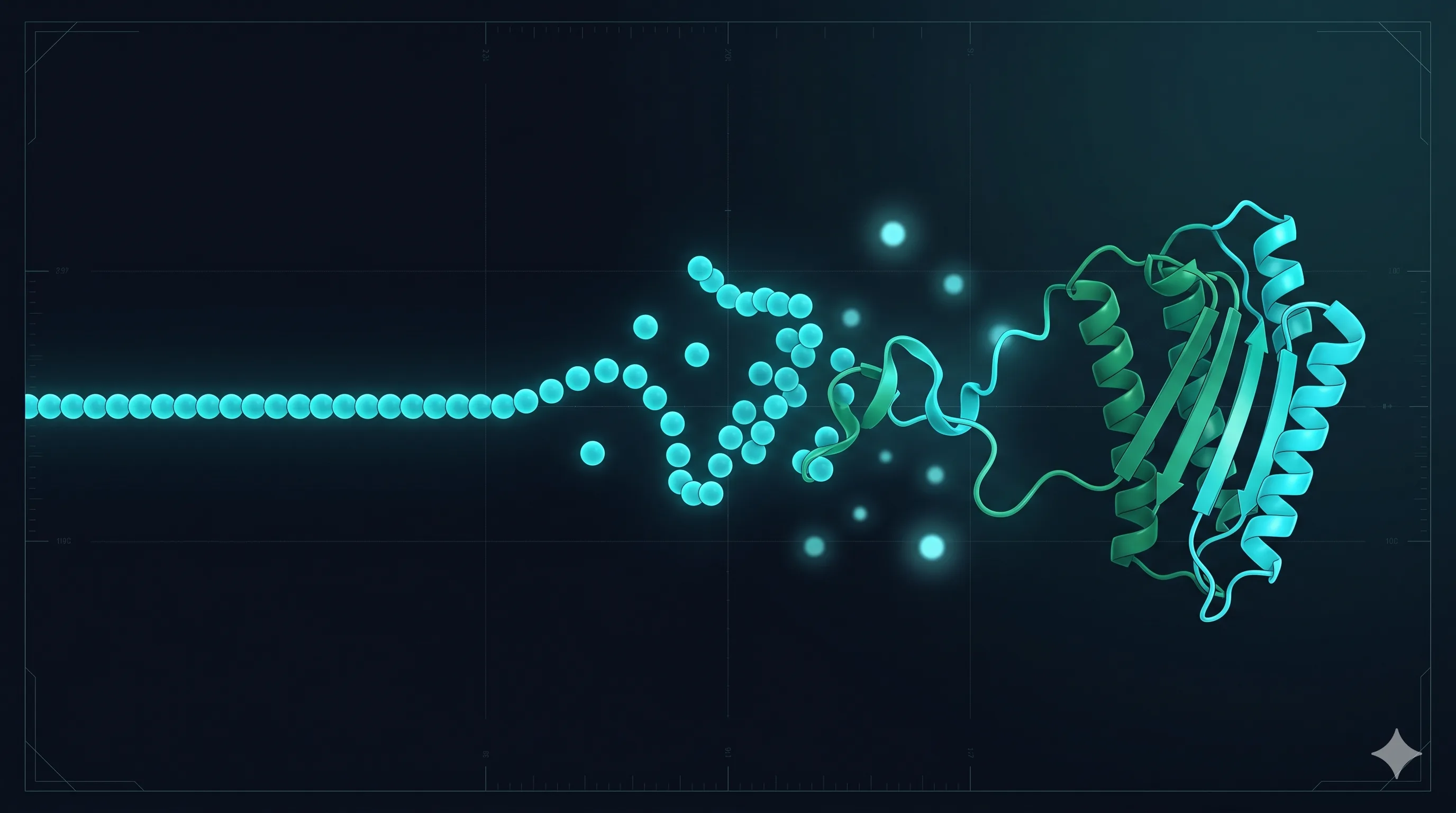
ESMFold single-sequence protein structure prediction
Fold a monomer from sequence alone. ESMFold reads embeddings from the ESM-2 protein language model and emits an atomic-level structure with per-residue pLDDT, no MSA required.
Use when MSAs do not help: orphan sequences, designed binders with no natural homologs, and any campaign where throughput matters more than the last decimal of accuracy.
Hosted at tools.ranomics.com. Funded from your wallet, with $5 free to start.
From a single sequence to an atomic-level fold
Submit sequence
Paste a single amino acid sequence or upload a FASTA. No homologs, alignments, or templates needed.
ESM-2 embedding
The 3B-parameter ESM-2 protein language model encodes the sequence into learned per-residue and pair representations.
Folding head
A lightweight folding module projects embeddings to atomic coordinates, replacing the AlphaFold2 Evoformer block stack.
Structure + pLDDT
Returns a PDB with per-residue pLDDT confidence and predicted aligned error, downloadable for downstream design and analysis.
A protein language model with a folding head
ESMFold is the structure-prediction head from Lin et al. (Science 2023) sitting on top of the ESM-2 transformer. The same paper used the system to fold the ESM Metagenomic Atlas, a release of more than 617 million predicted structures from metagenomic sequence.
Protein language model
Transformer pretrained on ~65M unique sequences from UniRef. Scaled to 15B parameters in the paper; ESMFold uses the 3B-parameter checkpoint that hits the accuracy-speed sweet spot.
Single-sequence inference
Co-evolutionary signal is learned implicitly during pretraining. At inference time no homolog search runs, removing the MSA bottleneck baked into the AlphaFold2 pipeline.
Embeddings replace alignments
Per-residue and pairwise embeddings from ESM-2 feed directly into the folding module, in place of the MSA representation used by Evoformer.
Calibrated per-residue confidence
Returns the same pLDDT score used by AlphaFold2, plus predicted aligned error. Low pLDDT regions flag intrinsic disorder or out-of-distribution input.
Single-chain output
ESMFold predicts monomeric folds only. For complexes, hand off to AlphaFold2 multimer or BoltzGen further down the Ranomics tools stack.
Speed-accuracy tradeoff, made explicit
Where ESMFold wins
Orphan sequences with no detectable homologs, designed binders with no natural alignment depth, and any setting where the alignment search adds no signal. Lin et al. show accuracy that matches AlphaFold2 single-sequence on low-MSA targets, without an MSA step at all.
Where ESMFold loses
MSA-rich targets where AlphaFold2 with deep alignments still leads on benchmark accuracy. Large multi-domain proteins, multimers, and any case that depends on inter-chain or template information. For those, prefer AlphaFold2 or BoltzGen.
Throughput at scale
The same paper used ESMFold to predict more than 617 million structures for the ESM Metagenomic Atlas. The same model on tools.ranomics.com lets you fold a large designed-binder pool or a full ortholog set in a single sitting, then promote the highest-confidence designs to AF2 or wet-lab validation.
The fastest fold when MSAs do not help
Most structure-prediction pipelines spend most of their effort building an MSA. For sequences with no natural homologs, that effort is wasted. ESMFold skips it entirely. The protein language model has already absorbed the co-evolutionary signal during pretraining.
That makes it the right default for de novo designed sequences emerging from RFdiffusion, BindCraft, and PXDesign campaigns, where alignment-based methods have nothing to work with.
Validating designed binders that have no natural homologs
Triaging large libraries of mutants or chimeras where AF2 throughput is the bottleneck
Folding orphan or synthetic sequences with no detectable alignment depth
Fast structural quality control on hits coming out of a de novo design pipeline
Quick monomer fold before running BindCraft or RFdiffusion against the structure
Browsing the structural neighborhood of a metagenomic hit before deeper analysis
From a predicted fold to a validated binder
A predicted structure on its own does not bind. Once a designed sequence folds the way you expect, the next step is wet-lab validation. Two entry points depending on scope.
Validate your designed binder in cells
The Binder Pilot is a short, fixed-scope de novo binder campaign with wet-lab validation included. Single-round, ranked hits, technical report. Scoped for academic labs, seed biotech, industrial SMBs, and student research groups.
See the Binder Pilot → Flagship programMulti-algorithm binder campaign
The AI Binder Sprint is a multi-algorithm de novo campaign (RFdiffusion, BindCraft, BoltzGen) over 6-8 weeks with milestone check-ins and a 100% binder guarantee. For teams building a binder pipeline on a hard deadline.
See the AI Binder Sprint →Fold your sequence today
Paste an amino acid sequence and get an atomic-level monomer structure with per-residue confidence. No MSA, no install, no setup.