
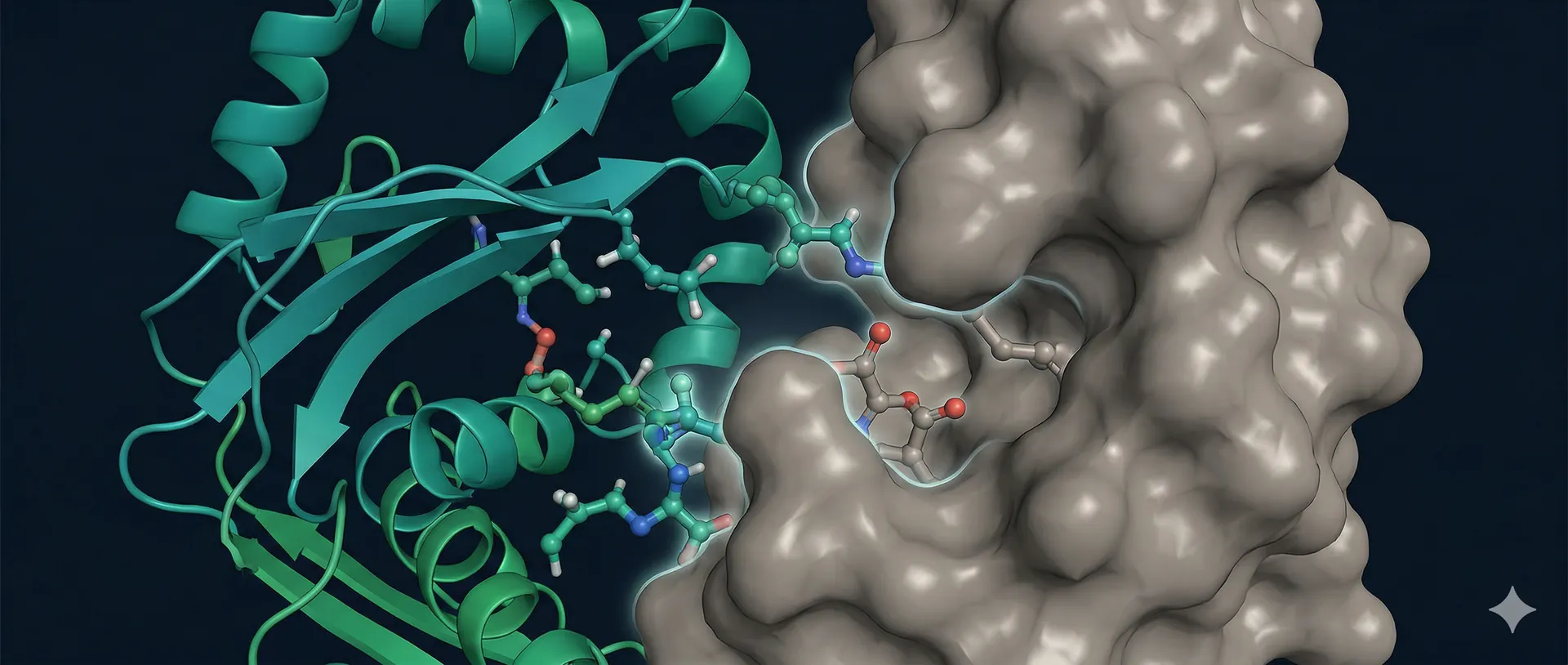
Affinity maturation services
Take an existing binder from micromolar to nanomolar or nanomolar to picomolar. Targeted mutagenesis libraries map every beneficial mutation and display selection confirms the best combinations.
Optimize your binder →Systematic protein binding optimization
Traditional affinity maturation relies on random mutagenesis and iterative selection — a process that explores sequence space blindly and often requires many rounds to achieve meaningful improvements. Our approach replaces randomness with data.
A targeted mutagenesis library of your lead binder — saturation scanning, combinatorial CDR diversification, or computationally guided variants — is screened on yeast display under binding selection. The resulting fitness landscape reveals every single-point mutation that improves affinity at every position. The top beneficial mutations are then combined into a focused combinatorial library and screened again.
This two-stage approach — comprehensive single-mutant mapping followed by rational combination — consistently achieves 10-100 fold improvements in Kd while preserving specificity and expression.
Single-mutant scanning
Saturation or targeted mutagenesis library screened for binding. Identifies every affinity-improving substitution across the binding interface and framework.
Beneficial mutation ranking
Mutations ranked by enrichment score. Positions with multiple improving substitutions flagged for combinatorial exploration.
Combinatorial library
Top 5-15 beneficial positions combined in a focused library. Defined sequence panel, not random — every variant is a designed combination.
Stringent selection
Combinatorial library screened under limiting antigen concentrations. The most improved variants are those that maintain binding under competitive conditions.
Protein formats for affinity maturation
Most campaigns mature antibody or nanobody formats — see antibody and nanobody engineering for discovery and humanization. Any scaffold that displays and sorts can be optimized the same way.
Nanobodies and VHH
Single-domain antibodies are ideal for maturation due to their small size (full saturation coverage in one library) and robust yeast display expression. Complete CDR and framework scanning in a single experiment.
scFv fragments
Single-chain variable fragments matured by scanning VH and VL CDR regions. Saturation or combinatorial scanning identifies improvements in both chains simultaneously, capturing inter-chain epistatic effects that single-chain optimization misses.
De novo designed binders
Computationally designed binders from RFdiffusion, BindCraft, or Boltzgen often bind in the low micromolar range. Iterative maturation through targeted mutagenesis and display selection is the standard follow-up to improve initial designs to application-relevant affinities.
Fab and IgG (via mammalian display)
Full antibody format maturation on mammalian display when native glycosylation or Fc function is important. Lower library diversity compensated by the biological relevance of hits selected in mammalian context.
Alternative scaffolds
DARPins, affibodies, fibronectin domains, and other non-immunoglobulin scaffolds. Our maturation approach is format-agnostic — any protein that can be displayed and sorted can be systematically optimized.
Bispecific constructs
Maturation of one arm of a bispecific while maintaining the other arm unchanged. Mutagenesis scanning focused on the target-binding interface of the arm being optimized.
Iterative display-based selection rounds
Each round of selection applies increasing stringency — lower antigen concentration, shorter incubation, or competitive off-rate selection — to progressively enrich for higher-affinity variants.
Concentration-based stringency
Sequential rounds at decreasing antigen concentrations. At limiting concentrations, only variants with improved on-rate or reduced off-rate maintain detectable binding. Multi-concentration titration series within a single sort provide apparent Kd rankings across the entire library.
Off-rate selection
Competition with excess unlabeled antigen after initial binding. Variants with slow off-rates retain labeled antigen longer and sort higher. Directly selects for the kinetic parameter most relevant to in vivo residence time and therapeutic efficacy.
A worked example: pH-dependent affinity maturation
Engineering pH-dependent binding via yeast surface display
640-clone targeted mutagenesis library, six FACS sort cycles, and convergent hotspot residues. Demonstrates the enrichment-score methodology and cumulative ranking that underpin our maturation campaigns.










Foundational papers in affinity maturation
The methods our maturation campaigns build on — from the display-selection theory to the antibody-engineering protocols.
Affinity maturation questions
What is antibody affinity maturation? +
Affinity maturation improves the binding strength (Kd) of an existing antibody, nanobody, or engineered binder. A targeted mutagenesis library of the lead is screened under increasing selection stringency so that tighter-binding variants are progressively enriched, then validated as soluble protein by SPR or BLI.
How much can affinity maturation improve Kd? +
Campaigns typically achieve 10 to 100-fold improvements in Kd while preserving specificity and expression. Starting from a weak lead, picomolar affinities are reachable — the classic Wittrup-lab yeast display work reached femtomolar binding on an antibody fragment.
Do you run affinity maturation on yeast display or phage display? +
Primarily yeast display, because flow-cytometric sorting gives a quantitative, per-clone affinity readout and lets us titrate antigen concentration and select on off-rate directly. Phage display suits very large naive libraries; for the focused maturation libraries used here, yeast display is the more precise platform.
Can you mature a de novo or AI-designed binder? +
Yes. Computationally designed binders from RFdiffusion, BindCraft, or Boltzgen often start in the low micromolar range, and display-based maturation is the standard next step to reach application-relevant affinity.
Can you mature full-length IgG or Fab formats? +
Yes, via mammalian display when native glycosylation, Fc function, or full-length assembly matters. Small formats such as nanobodies and scFv are matured on yeast display for maximum library diversity and the fastest cycle times.
What do you need from me to start an affinity maturation project? +
Your lead sequence and current affinity data (SPR/BLI, ELISA, or display titration), the target antigen, and your Kd goal. We design the mutagenesis strategy and selection scheme from there.
Technical articles on affinity maturation
Deep mutational scanning for antibody affinity maturation
How a full single-mutant fitness map turns affinity maturation from guesswork into a ranked, data-driven campaign.
pH-dependent antibody engineering: a case study
640-clone targeted library, six FACS sort cycles, and convergent hotspots from a real maturation campaign.
NNK vs NNS vs trimer codons for a VHH library
Choosing a codon scheme for the mutagenesis library that drives a nanobody maturation run.
Titrating display levels for reliable affinity data
Why apparent affinity must be normalized to display level before you trust a maturation ranking.
Yeast and mammalian display: the two-platform approach
Mature affinity on yeast, then validate developability on mammalian display. Costs and timeline.
Sorting strategies in surface display
Equilibrium vs kinetic sorting and how stringency schedules drive enrichment of higher-affinity variants.
Have a binder that needs tighter binding?
Share your lead sequence and current affinity data. We will design an affinity maturation campaign to reach your target Kd.
Start a project →