
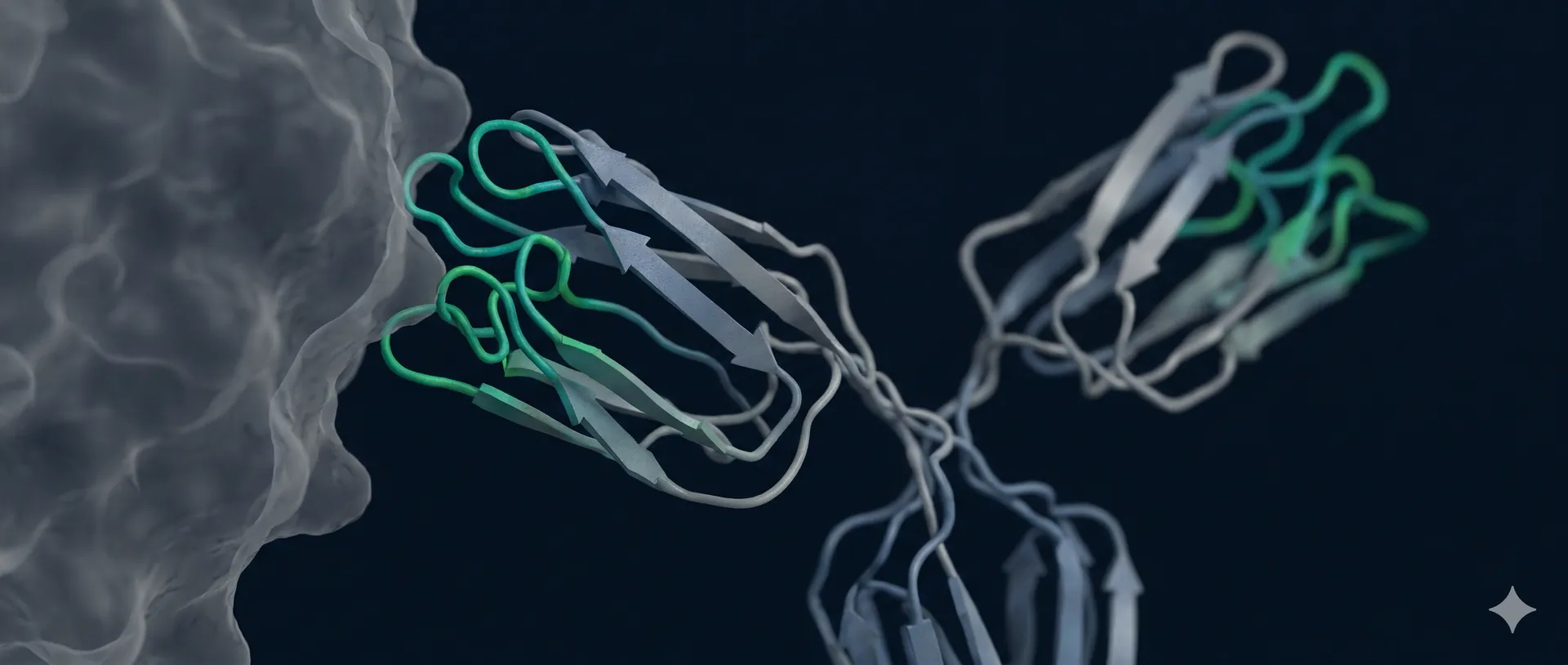
Antibody and nanobody engineering
From VHH discovery to humanized leads. Nanobody design, scFv optimization, and full antibody engineering powered by targeted variant libraries and display selection.
Start your antibody project →VHH nanobody design and optimization
Nanobodies — single-domain antibodies derived from camelid heavy-chain-only antibodies — are among the most tractable protein formats for engineering. At 12-15 kDa, the full sequence can be covered by a single saturation mutagenesis library, enabling complete DMS characterization in one experiment.
Their robust folding, high solubility, and tolerance of CDR loop diversification make nanobodies ideal substrates for both computational design (de novo binder generation via RFdiffusion and Boltzgen) and experimental optimization (targeted variant libraries, combinatorial CDR scanning, and affinity maturation on yeast display).
We work with nanobodies from immunized libraries, synthetic repertoires, and computational design pipelines. Whether you need to discover new VHH binders, mature existing leads, or humanize a camelid-derived nanobody for clinical development, our platforms handle the full workflow.
De novo VHH design
RFdiffusion and Boltzgen generate nanobody-format binders targeting specified epitopes. Designs validated by pooled yeast display screening.
VHH affinity maturation
DMS or combinatorial scanning of CDR loops plus framework residues. Complete affinity landscape in one experiment, with combinatorial optimization of top hits.
VHH humanization
Framework grafting onto human VH3 germlines with DMS-guided back-mutation selection. Identifies the minimal set of camelid residues required to maintain binding.
Multi-property optimization
Simultaneous DMS for binding, expression, and thermal stability. Identifies mutations that improve affinity without compromising developability properties.
Antibody fragment optimization and engineering
scFv engineering
Single-chain variable fragment optimization on yeast display. CDR mutagenesis for affinity improvement, linker optimization for stability, and VH-VL orientation testing. Simultaneous VH and VL scanning captures inter-domain epistatic effects.
Fab fragment optimization
Fab fragments displayed on yeast or mammalian cells. DMS scanning of CDR regions with native heavy-light chain pairing. Preferred when format fidelity to the final therapeutic product is important.
Full IgG engineering
Mammalian display of complete IgG molecules for campaigns where Fc function, glycosylation, or effector function is part of the selection criteria. Lower throughput compensated by direct relevance to the final clinical format.
Humanization
CDR grafting onto human germline frameworks followed by DMS-guided back-mutation selection. Instead of guessing which framework residues are important, DMS maps the contribution of every position and identifies the minimal non-human content needed.
Bispecific design
Engineering of individual arms for bispecific constructs. Each binding domain is optimized independently by DMS, then combined. Format options include tandem scFv, scFv-Fc, and knobs-into-holes architectures.
Developability optimization
Screening for aggregation propensity, polyreactivity, and self-association alongside binding activity. DMS identifies positions where affinity-improving mutations compromise developability, enabling informed trade-off decisions.
Matching antibody format to display platform
The choice of display platform depends on the antibody format, the importance of post-translational modifications, and the required library diversity. Nanobody and scFv campaigns run on yeast display; full-length IgG and glycosylation-dependent formats use mammalian display.
VHH, scFv, and small format antibodies
Highest library diversity (10^7-10^8), fastest cycle times, and robust quantitative FACS sorting. The default platform for nanobody and scFv engineering campaigns. Eukaryotic folding machinery handles most single-domain and single-chain formats well.
IgG, Fab, and glycosylation-dependent formats
Required for full-length IgG, when Fc glycosylation matters for effector function, or when the target epitope is glycan-dependent. Lower library diversity (10^5-10^6) but hits are directly relevant to the final production format.








Foundational papers in antibody and nanobody engineering
The display-based antibody-engineering methods our discovery and optimization campaigns build on.
Antibody and nanobody engineering questions
Do you offer nanobody (VHH) discovery as a service? +
Yes. We run de novo VHH discovery by yeast display — screening synthetic or immunized single-domain libraries against your antigen with quantitative FACS sorting and NGS hit calling — then follow up with affinity maturation and humanization on the same platform.
What is the difference between nanobody discovery and scFv discovery? +
A nanobody (VHH) is a single ~13 kDa domain, so an entire library can be saturation-scanned in one experiment. An scFv joins the antibody VH and VL domains with a linker, doubling the sequence to cover but capturing inter-chain effects. Both are displayed and sorted on yeast; format choice depends on your downstream construct.
Can you humanize a camelid nanobody? +
Yes. We graft CDRs onto human VH3 germline frameworks and use deep-mutational-scanning-guided back-mutation to identify the minimal set of camelid residues needed to preserve binding, lowering immunogenicity risk for clinical development.
Which display platform do you use for antibody engineering? +
Yeast display for VHH, scFv, and small formats — highest library diversity, fastest cycles, and quantitative FACS. Mammalian display for full-length IgG, Fab, and glycosylation-dependent epitopes, where hits are directly relevant to the final production format.
Can you optimize developability alongside binding affinity? +
Yes. Deep mutational scanning can score binding, expression, and thermal stability in parallel, flagging positions where an affinity-improving mutation would compromise developability. We pair this with a sequence-level liability scan for aggregation, polyreactivity, and self-association.
Do you work with AI-designed antibodies? +
Yes. Designs from RFantibody, RFdiffusion, and Boltzgen are validated and matured by display screening — the wet-lab step that separates a plausible model from a real binder.
Technical articles on antibody engineering
Nanobody discovery by yeast display
How synthetic and immunized VHH libraries are screened, sorted, and matured to deliver single-domain binders.
Yeast display for antibody discovery
Scaffold choices, library construction, MACS plus FACS sorting, NGS hit calling, and developability triage.
Natural, synthetic, and AI-designed antibody libraries
Choosing a discovery library strategy by target, timeline, and downstream format.
Deep mutational scanning for antibody affinity maturation
Turning a full single-mutant fitness map into a ranked, data-driven maturation campaign.
NNK vs NNS vs trimer codons for a VHH library
Picking the codon scheme that determines diversity and stop-codon load in a nanobody library.
5 developability red flags that kill mAb programs
The liabilities to screen out early, before an antibody lead advances toward the clinic.
Engineering an antibody or nanobody?
Tell us about your lead molecule, the format, and what you need to improve. We will recommend a platform and design an optimization campaign.
Start a project →